



































A stalled message consumer can look like an easy restart until it appears minutes before a financial settlement cutoff. Restarting it could interrupt transactions already in the queue. An AI agent can investigate under read-only permissions. Changing production requires a separate decision based on potential disruption.
That distinction sits at the center of AIOps remediation governance. The real decision rests on the available evidence, business conditions and recovery options for that task.
An IT automation approval matrix gives managed IT services teams a consistent answer. It separates routine diagnosis from controlled remediation and reserves human authority for actions whose consequences cannot be contained reliably. That is the purpose of human in the loop AIOps operations: placing review where judgment changes the outcome.
The stakes are material. Uptime Institute’s 2026 Annual Outage Analysis reported that 57% of respondents to its 2025 annual survey said their most recent major outage cost more than $100,000. Approval design deserves the same attention as detection speed.
Classify Automated Actions by Production Impact
Classify the action itself. Three classes provide a baseline, subject to stricter local policies.
Read only diagnostics
Querying metrics, checking job status, inspecting configuration differences, and collecting permitted log excerpts should generally run without individual sign-off. Yet read-only does not automatically mean harmless. Broad log retrieval can expose secrets; expensive queries can strain a struggling database. Access scope, query limits and redaction still apply.
Reversible fixes
Restarting an isolated worker, clearing an approved temporary cache or moving traffic away from one unhealthy instance may qualify for preauthorization. Conditions include verified target identity, contained impact, service health and a tested restoration path. Reversibility must be demonstrated for the specific system. A restart that drops in-flight transactions is not safely reversible merely because the process starts again.
High-impact changes
Database failover, privileged identity changes, firewall rule modifications, bulk message replay and production data deletion need additional review. Some may be urgent, but urgency alone does not make their impact predictable.
This classification is the first control in an IT automation approval matrix. The same command can move between categories when the affected service, customer commitments, or maintenance window changes. AIOps remediation governance therefore needs live context from service dependency mapping and business calendars, instead of permanent permissions based only on command names.
Build an Impact-by-Confidence Approval Matrix
Two questions should govern authorization: How serious is the likely consequence of a wrong action, and how reliable is the evidence supporting the proposed fix?
Impact should consider service criticality, downstream dependencies, data integrity, security privileges, customer exposure, and the time required to restore normal operation. A change on a single test node may have limited impact. The identical change on a shared authentication component may affect several business services.
Confidence should come from observable evidence, not simply a model-generated percentage. A credible recommendation can identify the failed component, correlate related alerts, rule out competing causes and show that the proposed runbook worked under comparable conditions. Conflicting telemetry, missing topology information or an unverified target should lower confidence.
Apply risk-based automation authorization through three decision bands:
- Low impact, strong evidence: Execute a preapproved runbook within defined limits, then verify its result.
- Moderate impact or incomplete evidence: Prepare the action and request approval from the accountable service owner or delegated operator.
- High impact, weak evidence or irreversible consequences: Block autonomous execution. Require investigation, an explicit change decision and any additional security or business authorization.
A high-confidence diagnosis should not automatically override a high-impact classification. The IT automation approval matrix should use the more restrictive decision whenever signals conflict.
For AIOps remediation governance, confidence is an input to policy, not a substitute for policy. The approval service must independently check the target, permitted action, current change restrictions, and whether required evidence is present.
Apply Guardrails to STRATA-Led Remediation Workflows
An agentic operating model makes the decision chain more important because several agents may contribute to a single recommendation. STRATA agentic IT operations controls should define where that chain can propose, approve, and execute production actions.
A practical design can assign distinct responsibilities across STRATA’s functions. Sense and Topology supply signals and dependency context. Reason and RCA assess probable causes. Change Risk assesses the potential impact of the proposed action, while Policy checks whether it meets defined authorization rules. Act carries out an authorized runbook, while Assure checks the resulting service state. These responsibilities require validation against the deployed STRATA configuration.
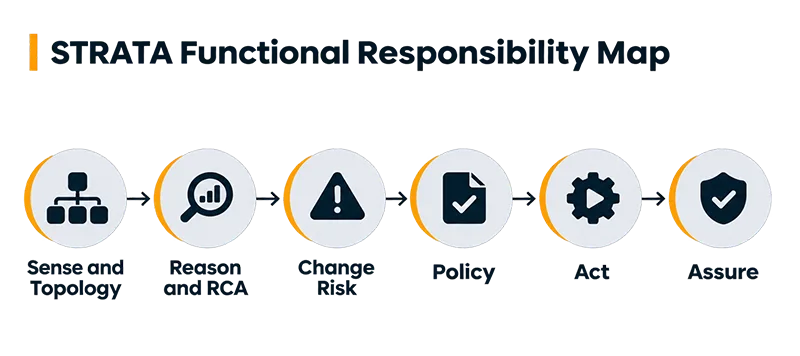
The automated remediation approval workflow should enforce the following boundaries:
- Separate proposal from execution
A diagnosis may suggest a command, but only a policy-controlled execution identity can run it. - Constrain credentials
Grant each runbook the minimum permissions required for its approved targets and actions. - Check operating conditions again
Revalidate service health, dependencies and change windows immediately before execution, even after approval. - Limit repeated attempts
Stop when recovery checks fail, the incident changes or the permitted retry budget is exhausted.
Under AIOps remediation governance, approval cannot become an unrestricted session. It should authorize a particular action, target, parameter set and expiry window. Changing any of those inputs requires a fresh decision.
The boundary must follow a proposed change across agents, without relying on the final agent to remember restrictions.
Require Audit Logs, Rollback and Exception Routing
Approval must be enforceable at execution time. A chat message saying “approved” offers little protection if a runbook can still execute without checking the recorded decision. The automated remediation approval workflow should pause execution until an authorized reviewer accepts the exact change. AWS Systems Manager Automation, for example, documents an aws:approve action that holds a runbook pending an approval decision.
Each request should show the reviewer the affected service, evidence summary, proposed command or configuration difference, expected effect, potential business interruption and recovery instructions. The request must expire if the operational context changes.
Keep an audit trail that links the incident, agent recommendation, policy evaluation, approver identity, runbook version, execution parameters, timestamps, commands and post-action checks. Capture rejections and expirations, which reveal where controls intervened.
A rollback policy for IT automation should distinguish stopping an action from reversing its effects. Canceling a deployment can prevent further changes without restoring instances already modified. Reverting a credential rotation may be inappropriate if the original credential was compromised. The recovery path must match the action.
Every approved runbook needs a defined success test, a stop condition and a named recovery owner, consistent with AWS resilience runbooks. Test feasible rollback paths before unattended execution. AWS Systems Manager also supports stopping an automation when a monitored CloudWatch alarm enters the alarm state. This is a useful safety gate, although stopping the workflow does not reverse completed changes.
Exception handling needs equal care. When an approval owner is unavailable, route the request to a documented delegate. When a critical incident requires emergency change, record the incident commander, emergency authority, reason and later review. An expired request must remain unauthorized.
The IT automation approval matrix must capture these exception paths, especially for overnight support and services with hard business cutoffs.
Assign Approval Owners and Define Decision Thresholds
An approval requirement without a reachable owner becomes an operational bottleneck. Identify the authority for each type of risk before an incident occurs.
The service owner should approve changes affecting business availability or transaction integrity. The platform or database owner should review technical recovery actions. Cybersecurity services teams should authorize material privilege, identity or network-policy changes. The incident commander coordinates emergency decisions but should not automatically inherit authority to override every security restriction.
In human in the loop AIOps operations, the reviewer needs enough context to make a real decision. Displaying an alert count without affected dependencies, failure evidence or recovery options turns sign-off into an administrative step.
Set thresholds around observable conditions rather than vague labels such as “minor issue.” Relevant thresholds include the number of affected nodes, outstanding transactions, retry frequency, health-check status, active business cutoffs and permitted execution windows. Set values through service risk assessment and runbook testing.
Review risk-based automation authorization whenever an application dependency changes, a runbook is revised or a recovery action produces an unexpected result. Under the IT automation approval matrix, previous approval should not follow a workflow indefinitely as the environment changes.
Sample IT Automation Approval Decision Table
The following table illustrates policy decisions. It is a starting point for service-specific validation, rather than a universal authorization standard.
| Proposed IT action | Required conditions | Approval decision |
| Read permitted metrics and sanitized logs | Scoped access, query limits, audit capture | Run automatically |
| Restart an isolated stateless worker | Known target, no protected business window, proven health checks | Preapprove; stop if verification fails |
| Replay queued transactions | Idempotency confirmed, duplicates checked, downstream owner identified | Service owner approval |
| Change a production firewall rule | Security impact assessed, rule difference reviewed, recovery plan recorded | Security and service owner approval |
| Fail over a production database | Replication and recovery state verified, application impact reviewed | Database owner and incident authority approval |
| Purge production records or delete backups | Exact scope, dependencies and consequences reviewed | Explicit data-owner and change-authority decision; no autonomous execution |
Use the table to translate the rollback policy for IT automation into actual execution gates. A rollback-ready worker restart may qualify for unattended action, while a destructive database command cannot inherit that permission simply because both appear in the same incident runbook.
A final check should compare approved parameters against executed parameters. That prevents a later agent from widening a target list after sign-off. Incident simulations can test STRATA agentic IT operations controls against each decision’s expected result.
Check Whether the Approval Rules Work in Practice
Evaluate AIOps remediation governance beyond remediation speed. Examine actions blocked by policy, approvals that expired, emergency overrides, repeated recovery attempts, rollback success and incidents where a proposed fix worsened service health. Review these findings alongside restoration time and business interruption.
The IT automation approval matrix should flag approvals granted without adequate evidence and actions that passed technical checks but missed business verification. Periodically replay past incidents in a safe test environment to see whether current rules would make the same decision. When a service dependency or operating window changes, retest the affected policy.
Repeatedly successful, constrained fixes can become candidates for preauthorization after formal review.
Make Every Remediation Decision Accountable
The goal of AIOps remediation governance is to make production authority explicit before an agent needs it. Teams should begin by classifying actions, validating recovery paths and assigning the people who can approve exceptional risk. Then convert those decisions into enforceable runbook gates.
An effective IT automation approval matrix lets safe diagnostics proceed, allows bounded fixes when evidence supports them and stops consequential changes until the right people review the risk. That balance improves response discipline without making engineers approve actions that existing controls can safely handle.
Author


Yogita Jain
Content Lead
Yogita Jain leads with storytelling and Insightful content that connects with the audiences. She’s the voice behind the brand’s digital presence, translating complex tech like cloud modernization and enterprise AI into narratives that spark interest and drive action. With a diverse of experience across IT and digital transformation, Yogita blends strategic thinking with editorial craft, shaping content that’s sharp, relevant, and grounded in real business outcomes. At Cygnet, she’s not just building content pipelines; she’s building conversations that matter to clients, partners, and decision-makers alike.