




































A failover instruction may be one line long. The decision to execute it requires considerably more judgment. A database replica may appear healthy while lagging behind the primary. A standby application could be running but unable to authenticate users or process transactions. Switching traffic under these conditions may create another operational problem before the original failure is resolved.
This is where AWS resilience runbooks become essential to cloud recovery, with cloud operations services supporting recovery coordination and operational readiness. They establish what must be checked before initiating recovery, who can authorize disruptive actions, how dependencies should be restored, and what evidence confirms that the application is functioning as expected.
Well-structured cloud incident runbooks also address situations where the planned recovery path becomes unavailable. They define escalation routes, alternative actions, and clear conditions for stopping an unsafe procedure.
Recovery readiness depends on how well these decisions are documented, practiced, and executed when normal operating conditions no longer apply, making AWS operational readiness an important consideration before production.
What AWS Resilience Runbooks Must Decide Before an Outage
Recovery documents often start after the hardest decision: whether restoration is justified, feasible, and authorized.
A useful runbook answers five questions. What evidence confirms the failure? What conditions make the proposed recovery safe? Who owns execution and approval? Which systems must recover first? What evidence allows the incident commander to declare the business service usable?
Place those answers beside commands, dashboards, and escalation contacts. Cloud incident runbooks also need an explicit stop condition. If replication is behind, the standby environment is unhealthy, or an identity service is unavailable, the procedure should direct the operator to an alternative path rather than encouraging repeated attempts.
The next action should depend on observed conditions rather than individual familiarity with the architecture.
Prioritize Cloud Failure Scenarios by Business Impact
A catalog of theoretical failures soon becomes unmanageable. Start with workloads whose interruption prevents a business transaction, exposes data, or delays a time-sensitive operation. Map their dependencies and the failures likely to break those paths.
| Failure scenario | Decision the runbook must support | Recovery evidence |
| Availability Zone impairment | Keep serving traffic elsewhere or initiate a zonal traffic shift | Healthy capacity and successful application requests |
| Regional service disruption | Continue locally, degrade gracefully, or approve regional failover | Standby readiness, replication state, and live user transactions |
| Database corruption or deletion | Select a safe recovery point and isolate affected writes | Restored data integrity and acceptable data-loss exposure |
| Identity or network dependency failure | Use an approved access or connectivity fallback | Operators can reach recovery tooling and applications can authenticate |
Failover instructions should reflect the deployed architecture, making cloud engineering services important for designing and validating recovery dependencies. An application distributed across Availability Zones may recover through existing redundancy; a single-Region database cannot be assumed to have a working cross-Region copy. Cloud recovery playbooks fail when prerequisites exist only in architecture diagrams.
Assign each scenario a recovery time objective (RTO) and recovery point objective (RPO). Then state which customer journeys must return first. These priorities tie recovery to AWS business continuity requirements.
Incident Response AWS: Ownership and Escalation
Recovery stalls when multiple teams can identify a problem but nobody can approve the next action. An incident commander should control priorities and communications, while a designated technical lead verifies the evidence and coordinates execution. Application, database, security, and business owners contribute at specific decision points.
Distinguish the operator, the approver accepting the risk, and the person validating results. Smaller teams may combine roles, but authority must remain explicit.
Document who may accept data loss, disable writes, reroute traffic, or invoke emergency access. Provide a named backup for each role and an escalation threshold based on elapsed time or worsening customer impact.
Cloud incident runbooks need fallback communications if collaboration or identity services fail. Instructions must remain accessible outside the failed service.
Build Runbooks Around Decision Gates and Observable Results
An engineer unfamiliar with the document should be able to execute it under pressure. Separate fixed facts, such as resource identifiers and access requirements, from decisions that depend on live telemetry.
Each entry in AWS resilience runbooks should capture:
- Trigger: Relevant alarms, affected transactions, and the evidence needed to confirm scope.
- Preconditions: Required IAM permissions, healthy recovery resources, backup state, and network access.
- Decision gate: Who approves the action and what conditions would block it.
- Execution: Verified commands or automation documents, with expected output after each step.
- Abort path: When to stop, how to contain side effects, and whom to contact.
- Acceptance: Functional checks, data checks, and the authority to close the incident.
Keep secrets out of the document. Reference an approved access method and test that it works during degraded conditions. Store a protected copy of critical instructions outside the workload’s likely failure boundary.
AWS Systems Manager Automation can execute approved operational steps, while AWS Resilience Hub can recommend standard operating procedures, alarms, and recovery tests based on assessed application components. Automate approved steps with defined prerequisites, permissions, and error handling. Keep destructive decisions subject to explicit authorization.
This structure turns cloud incident runbooks into controlled procedures with a visible record of what was attempted and why.
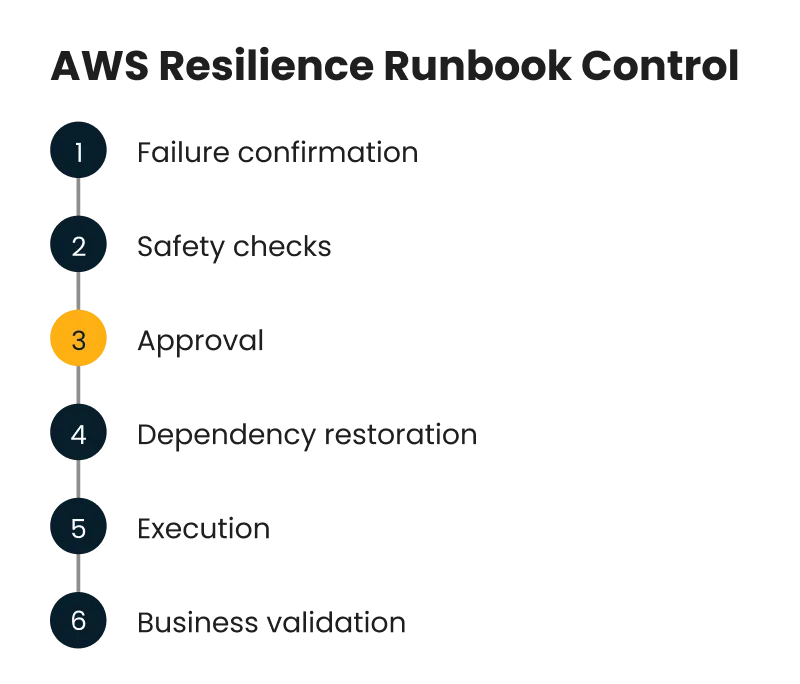
Document AWS Failover Procedures With Dependency Checks
A regional switch may require replica promotion, prevention of conflicting writes, standby capacity checks, and traffic redirection. Each action changes the safety of the next.
Consider an ordering application whose primary database becomes unreachable. Switching DNS while the standby has stale inventory data could allow duplicate orders or incorrect allocations. The runbook should state how replication lag is assessed, who accepts the potential data loss, and whether the application must temporarily become read-only.
Amazon Application Recovery Controller (ARC) routing controls support traffic redirection between prepared regional replicas. AWS recommends its highly available routing-control data-plane APIs for recovery actions instead of relying on console configuration changes during an incident. These controls require prior setup, tested credentials, and an independently prepared standby.
The second half of AWS failover procedures deserves equal attention: returning traffic to the original environment. Define conditions for failback, data reconciliation, and ownership of the active writer. Otherwise, a successful emergency move can create a second outage during normalization.
Validate Restoration Beyond Green Infrastructure Dashboards
Running EC2 instances and healthy load balancers cannot prove an order was accepted or payment recorded. Recovery acceptance needs application and business evidence.
Validate from infrastructure through user outcomes. Confirm network and identity access, application dependencies, data consistency, and then a small set of synthetic or controlled business transactions. Check delayed queues, scheduled jobs, external integrations, and error rates after traffic resumes.
AWS Backup supports scheduled restore testing and optional validation workflows after restoration. This helps demonstrate that recoverable data can actually be accessed. A completed restore job still needs verification against workload RTO and RPO, along with any application-level integrity requirements.
For example, restoring an order database without restoring the message consumer may leave accepted orders unfulfilled. Cloud incident runbooks should identify the backlog, safe replay conditions, and downstream verification owner. The final acceptance record should distinguish technical restoration, customer-facing restoration, and remaining cleanup work.
Recovery guidance must prevent healthy infrastructure metrics from being mistaken for incident closure.
Use Failure Simulations to Expose Runbook Weaknesses
A walkthrough reveals missing instructions. An actual exercise reveals missing permissions, stale identifiers, slow approvals, and assumptions about services that remain available. Each exercise needs a failure hypothesis and measurable outcome.
AWS Fault Injection Service (FIS) supports controlled experiments involving selected workload disruptions. CloudWatch alarm-based stop conditions can terminate an experiment when predefined thresholds are breached. AWS Resilience Hub can also recommend fault-injection experiments aligned with an assessed application.
Build operational resilience testing in stages. Begin with tabletop decisions, proceed to isolated component tests, then exercise application recovery and coordinated failover where appropriate. For production experiments, establish a bounded scope, change approval, rollback plan, and monitoring independent of the fault being introduced.
Measure more than elapsed recovery time. Record the time taken to recognize impact, obtain authority, reach the recovery tool, execute the procedure, and verify a customer transaction. These intervals show whether AWS resilience runbooks shorten decision delays.
A failed exercise should produce a corrected procedure, owner, and retest. A passed exercise that ignores unresolved errors creates false confidence.
Keep Recovery Instructions Current as Workloads Change
Runbooks decay quietly. Teams replace database engines, move authentication dependencies, change IAM roles, add third-party interfaces, or update deployment paths. Their commands may silently reference obsolete resources.
Attach review triggers to operational changes rather than relying only on calendar reminders. A significant architecture change, a revised recovery objective, a production incident, or a failed simulation should prompt a targeted review. Keep the procedure in version control with a named owner, a last-tested record, and links to approved automation.
Cloud incident runbooks should be updated with evidence from actual incidents, including workarounds that succeeded and actions that unexpectedly worsened conditions. Exclude incident transcripts. Extract repeatable decisions and commands, then verify them before adoption.
Operational resilience testing frequency should reflect workload criticality and change rate. Critical payment services may justify more frequent exercises than internal reporting applications, with additional tests following material changes. Frequency alone is a poor indicator of preparedness.
Assess Whether Managed AWS Operations Can Execute the Plan
For organizations evaluating AWS consulting services, recovery preparedness should be part of the service assessment. Monitoring coverage and response targets cannot establish that engineers can safely run a cross-Region failover or database restoration.
Ask to inspect a workload-specific runbook, the ownership matrix, evidence from the latest restoration test, and the process for maintaining emergency access. Request an explanation of which decisions remain with the customer and which actions the provider may perform under preapproved authority. In evaluations of incident response AWS services, unclear decision rights expose an operational gap.
The assessment should also examine whether cloud recovery playbooks cover third-party dependencies, business transaction validation, and failback. A demonstration using a low-risk scenario can reveal more than a broad list of supported AWS services.
Useful engagement outcomes include a prioritized scenario register, verified recovery procedures, an exercise schedule, and a remediation list with owners. These deliverables make AWS business continuity plans actionable and ongoing operations auditable.
Put AWS Resilience Runbooks Through a Real Recovery Test
Recovery readiness is demonstrated when an engineer can make the next safe decision with the systems, evidence, and permissions actually available during an outage. That demands preparation and repeated testing.
Begin with a business-critical workload. Test one credible failure, measure the complete path back to a working transaction, and correct the gaps before expanding coverage. AWS resilience runbooks become more dependable when every exercise ends with a verified change in operational practice.
For teams reviewing cloud incident runbooks with an AWS managed services partner, the next step is a scenario-based resilience assessment that tests decision ownership, recovery execution, and business-level acceptance together.
Author


Yogita Jain
Content Lead
Yogita Jain leads with storytelling and Insightful content that connects with the audiences. She’s the voice behind the brand’s digital presence, translating complex tech like cloud modernization and enterprise AI into narratives that spark interest and drive action. With a diverse of experience across IT and digital transformation, Yogita blends strategic thinking with editorial craft, shaping content that’s sharp, relevant, and grounded in real business outcomes. At Cygnet, she’s not just building content pipelines; she’s building conversations that matter to clients, partners, and decision-makers alike.