



































A DNS record can pass every syntax check and still interrupt a business service. A valid target may belong to the wrong environment. A retired hostname may remain in an authentication redirect. A cutover may look complete while an office resolver returns the previous address.
The October 2025 AWS disruption provides a particularly sharp reminder. A defect in automated DNS updates left the regional DynamoDB endpoint without its expected IP addresses. Dependent services, including EC2 instance launches, experienced problems that continued after the DNS record was restored.
The operational lesson is about the distance between publishing a record and restoring a service. DNS change governance must account for both. Effective enterprise DNS management connects technical records to business processes, assigns a decision owner, and verifies results from the networks where applications actually run, supported by infrastructure management services.
Why DNS Changes Disrupt Identity, APIs, and Business Applications
DNS sits on paths that are rarely visible in an application support ticket, making service dependency mapping important for identifying hidden connections between identity, APIs, and business applications. An employee signs in through an identity provider whose custom domain must resolve. A payment API uses a partner hostname. An ERP integration depends on an internal zone available only through a corporate resolver. Email delivery depends on MX records and related authentication settings.
These dependencies have different failure symptoms. A broken login hostname appears as an identity problem. A stale API alias looks like a timeout. A split-horizon DNS error may affect office users while remote employees work normally. Application monitoring can report all three as unrelated incidents.
Trace each name through three states: intended zone configuration, resolver answer, and completed application transaction. Each state can be correct or wrong independently. A successful record update proves only the first.
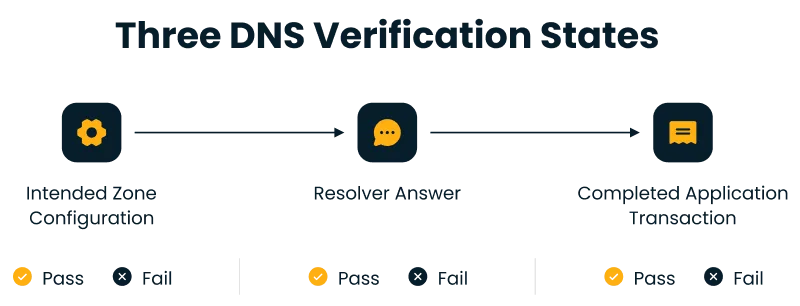
The question of how to prevent DNS configuration outages becomes easier to answer when DNS changes are reviewed against this dependency chain, rather than treated as isolated network edits.
Build a DNS Zone Inventory With Named Record Owners
A zone export is a useful beginning, but it cannot explain whether a record still matters. Inventories need to include public and private hosted zones, delegated subdomains, registrar settings, DNSSEC dependencies, forwarding rules, and records managed through cloud platforms or external providers.
For each critical record, document its service and the team authorized to approve an interruption. The infrastructure administrator may control the DNS platform without owning the payroll service or customer portal behind the hostname.
A DNS record ownership enterprise model becomes workable when it separates technical custody from business accountability. The register should capture these fields.
| Inventory field | What it should establish |
| Name, type, zone, and environment | The exact record and where its answer is authoritative |
| Service and dependency | Which login, API, workflow, or business process uses the name |
| Technical custodian and service owner | Who makes the change and who accepts its business risk |
| Source of configuration | Console, infrastructure-as-code repository, or external DNS provider |
| TTL, last review, and retirement trigger | How caching and decommissioning will be handled |
Discover records through provider APIs, configuration repositories, application inventories, certificate records, and resolver query logs where available. Passive discovery can miss names used only during month-end or recovery tests.
Good enterprise DNS management also requires an exception queue, with managed IT services supporting ownership reviews, escalation, and resolution tracking. An ownerless record should not automatically be deleted. Mark it for investigation, identify recent consumers, and impose a review deadline. DNS change governance becomes meaningful when unresolved ownership is visible before the next release.
How to Prevent DNS Configuration Outages With Risk-Based Reviews
Not all DNS edits deserve the same approval path. Updating a low-risk test alias differs from modifying an identity-provider hostname, replacing nameservers, or changing routing for an externally consumed API. Review effort should match business impact.
Enterprise DNS management should distinguish routine changes, coordinated releases, and high-risk changes. Routine edits follow approved templates and automated validation. Coordinated releases need the service owner, technical custodian, and release manager to agree on timing. High-risk updates need independent review, a tested recovery path, and an explicit stop condition. For automated changes, check revision freshness at write time to prevent a delayed worker from overwriting newer DNS state. Log the applied revision.
Before approval, require a change package that answers:
- Which applications, environments, and external partners use this name?
- What are the existing and proposed record values, including IPv6 and related aliases?
- Which resolver paths may return a different answer, and for how long?
- What evidence will confirm the business transaction works after the change?
- Who can authorize rollback, and what conditions will trigger it?
DNS change governance protects release teams from risks an ordinary ticket misses. DNS monitoring and change approval should share the same record identifiers so alerts can be traced to the release that changed them.
DNS TTL Planning for Application Cutovers
TTL is a caching instruction, not a guaranteed worldwide switch time. Shorter values help resolvers discover changes sooner, while increasing query traffic. Clients may also retain connections after the DNS answer changes.
DNS TTL planning for application cutovers should begin before the release window. If a record currently carries a long TTL, lower it sufficiently early for previously cached answers to expire. Test the new destination, perform the update, and retain the old destination long enough to accommodate cached answers and active sessions. Restore a suitable steady-state TTL after verification.
An additional trap is negative caching. Resolvers can cache NXDOMAIN and NODATA responses according to the zone’s SOA settings. Creating a previously nonexistent hostname immediately before an application release may therefore leave some clients seeing an earlier negative answer.
Enterprise DNS management needs procedures for positive answers, negative answers, and delegated zones. Shortening an application record’s TTL does not automatically shorten caching on its CNAME target or upstream NS delegation.
Remove Stale DNS Records and Shadow Subdomains
The most dangerous record in an inventory may be one that still resolves after the application has been retired. A CNAME pointing to a deleted cloud resource can create a subdomain takeover opportunity when the abandoned target can be claimed by someone else, highlighting the importance of cybersecurity services for DNS security and risk management. Microsoft documents this risk in Azure.
Shadow subdomains bring a different control failure. A department may create a marketing hostname through a third-party platform without placing it under the normal DNS review process. It works until a contract ends or a hosted account changes.
Treat DNS retirement as part of application retirement. Confirm downstream consumers, remove references in application settings, verify provider-side resource ownership, and remove obsolete records in the correct order. Certificates, authentication callback URLs, and webhook configurations can all preserve hidden dependencies.
The DNS record ownership enterprise model should assign a retirement approver as well as a creation approver. DNS change governance also needs periodic reviews of external CNAME targets, wildcard entries, delegated zones, and abandoned test names. A technically valid hostname is not evidence of a current business need.
Test DNS Resolution From Multiple Locations
One administrator’s lookup cannot validate an enterprise change. Internal resolvers may serve private answers. Branch offices may use forwarding rules. Public resolvers can have different cached responses, and regional traffic steering may deliberately return different endpoints.
Build a small test matrix based on actual access routes: corporate network, remote access, cloud workload, and public internet. Check authoritative responses, recursive responses, A and AAAA records, CNAME chains, DNSSEC validation where enabled, and the resulting application connection.
The strongest test is a completed transaction, such as a successful federated login or a harmless request through the API gateway, consistent with AWS operational readiness practices that validate real application behavior. A record returning the expected IP address does not prove that the endpoint accepts the correct host header, presents a valid certificate, or can reach its backend.
During an application cutover, capture the old and new answers throughout the change window. Differences then expose normal caching or unexpected configurations. DNS change governance should require evidence from affected user locations before the release is closed.
Create DNS Monitoring and Rollback Playbooks
Detection should distinguish configuration drift from a service outage. Compare approved records with live authoritative answers. Separately test recursive resolution and service availability from representative networks. Alert on unauthorized NS changes, missing critical records, unexpected CNAME targets, DNSSEC failures, and resolution inconsistencies that persist beyond the expected window.
Effective DNS monitoring and change approval joins the alert to the change ticket, named owner, last known good values, and affected service. Without that context, an on-call engineer must reconstruct the release during an incident.
A rollback playbook should state what can actually be reversed. Restoring a prior record in the authoritative zone does not immediately clear cached bad answers. Keep the previous endpoint available where feasible, and prepare alternate access procedures for services that cannot tolerate the delay. For nameserver or DNSSEC changes, rollback must also account for delegation and DS records. For severe incidents, account for dependency recovery after resolution returns.
A useful response sequence is:
- Freeze conflicting changes and preserve the current zone snapshot.
- Compare approved and observed answers across authoritative and recursive paths.
- Restore the last known good state or invoke an already tested routing alternative.
- Confirm application transactions from the affected networks before declaring recovery.
Enterprise DNS management improves when incident reviews identify which control failed: inventory, approval, deployment validation, resolver visibility, or rollback preparation. DNS change governance should target the failed control rather than introduce another blanket approval layer.
Enterprise Domain Name System Audit Checklist
A workable enterprise domain name system audit checklist tests operational readiness, not merely whether records exist. Review a representative business-critical zone and ask whether its owner can demonstrate:
- A named service owner, technical custodian, and current dependency map.
- Approved change history, access permissions, and an accurate source of configuration.
- TTL settings, negative caching assumptions, and release procedures.
- Evidence of stale-record review, delegated-zone oversight, and retirement checks.
- Resolution tests across required networks and application-level acceptance results.
- Monitoring ownership, incident routing, and a recoverable last known good state.
Extend the audit to changes made outside the central DNS console as well. An automated deployment or a third-party platform update can introduce the same failure as a manual edit. Findings should enter a tracked remediation backlog with clear owners and deadlines.
Make DNS Changes Accountable to Business Outcomes
A successful DNS deployment is only an intermediate result. The real acceptance test is whether employees can authenticate, integrations can exchange data, and customers can complete the transactions that depend on the affected names.
That standard gives enterprise DNS management a useful operating boundary. Records have owners, changes have risk-based approval paths, and recovery plans account for caching and application behavior. DNS change governance then becomes a repeatable way to protect business continuity without holding every routine update for a committee.
Author


Yogita Jain
Content Lead
Yogita Jain leads with storytelling and Insightful content that connects with the audiences. She’s the voice behind the brand’s digital presence, translating complex tech like cloud modernization and enterprise AI into narratives that spark interest and drive action. With a diverse of experience across IT and digital transformation, Yogita blends strategic thinking with editorial craft, shaping content that’s sharp, relevant, and grounded in real business outcomes. At Cygnet, she’s not just building content pipelines; she’s building conversations that matter to clients, partners, and decision-makers alike.