


































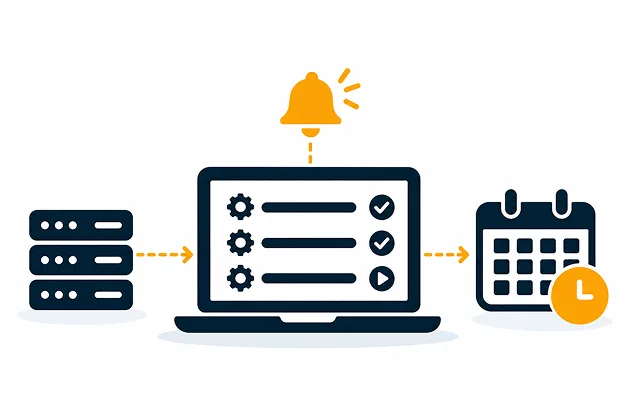
An overnight job can finish successfully while the business process it supports remains incomplete. The scheduler reports a clean run, yet finance cannot close the ledger because a reconciliation file contains only part of the expected data. By the time that discrepancy reaches the support queue, the morning cutoff may already be lost.
This is the weakness in treating job status as proof of business readiness. Batch job monitoring must answer a harder question: will the required output be complete, accurate, and available when another team needs it? For application managed services, that distinction changes what gets watched, when an incident begins, and who can declare the cycle complete.
Batch assurance starts with a business deadline and works backward through dependencies, recovery options, and validation. The aim is to detect a threatened cutoff while time remains to protect it.
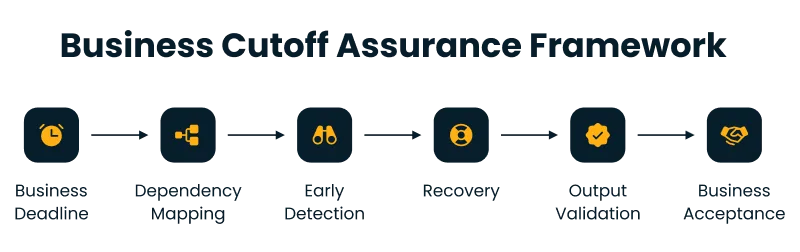
Define the Business Cutoff Before Monitoring Job Status
A business cutoff is the latest acceptable point at which verified output must be ready. It might govern distribution, payment submission, stock updates, or financial close. The scheduler’s planned end time is an operational target; the cutoff governs the receiving team’s work.
Each critical workflow needs a short cutoff contract. It should record the business event, the required output, the acceptance check, the deadline, and the people authorized to decide what happens if delivery is threatened. Include the time needed for reconciliation and signoff. A job that completes a minute before the deadline may still be late if its results require review.
This contract should be agreed upon with process owners instead of relying solely on existing scheduler settings. Older schedules may contain obsolete predecessors or deadlines unrelated to current operations.
A useful distinction is between three states:
- Executed: The scheduler confirms that the job ended according to its configured rules.
- Validated: Required records, totals, files, and control checks meet agreed acceptance criteria.
- Business-ready: The receiving process has accepted the output, or an approved rule permits automatic release.
In practice, batch job monitoring becomes meaningful when those states are recorded separately. A green execution status must not quietly substitute for a verified handoff.
Map Upstream and Downstream Batch Dependencies
Sales postings may depend on an interface; inventory refreshes on warehouse extracts; reporting loads on source data and currency rates. The visible failure may appear in the last job, although the delay began upstream.
Start with the business output and trace backward through file arrivals, API responses, loads, application jobs, approvals, and external feeds. Then trace forward to identify what becomes unusable if delivery is late. This reveals the critical path beyond one scheduler.
Job scheduler dependency tracking is useful inside an orchestration platform, but enterprise workflows often cross tools and teams, making service dependency mapping essential for identifying hidden operational risks. A scheduler may know that a file arrived without knowing whether its contents belong to the correct accounting period. The dependency register therefore needs both technical conditions and business acceptance rules.
For ERP batch processing failures, this distinction is especially important, particularly when SAP managed services support critical business processes. A posting program may finish while rejected records remain in an application log or a downstream extract reflects an earlier run. SAP’s background processing guidance, for example, distinguishes job status from the job log and any generated spool output. These are separate sources of operating evidence.
An application managed services dependency map needs the predecessor, arrival window, data period, downstream consumer, and recovery owner, supported by data engineering services for reliable data pipelines and processing. Add a cycle identifier so yesterday’s file cannot pass today’s readiness check.
This is where batch job monitoring gains context. An isolated job failure might be recoverable within the window; a missing upstream feed can threaten several downstream handoffs at once.
Track Lateness, Retry Storms, and Incomplete Outputs
Early warnings can appear before a failure: a delayed start, unusually short run, repeated restart, or shrinking recovery window.
SLA monitoring for scheduled jobs should use the forecast completion of the full workflow, including validation and handoff. Control-M documents views of expected completion, deadlines, and slack time. The principle extends across schedulers: compare time remaining with work outstanding.
The following signals deserve different responses:
| Signal | What it could mean | Operational check |
| Late start | Upstream data or capacity is unavailable | Identify the blocking dependency and revised finish time |
| Long runtime | Data volume, locks, or processing contention has changed | Compare progress and remaining workload with the cutoff |
| Retry storm | A recurring error is consuming recovery time | Stop uncontrolled retries and inspect replay safety |
| Short successful run | Processing may have skipped records or selected an empty period | Check input counts, exceptions, and output totals |
| Output delivered late | Downstream consumption or approval may be blocked | Confirm receipt, data period, and business acceptance |
Retries need care. Replaying postings without checking idempotency can create duplicates; restarting an extract too early may publish inconsistent data. Runbooks must specify when to retry, resume, reverse work, or hold downstream release.
Job scheduler dependency tracking should also expose jobs that never start because their trigger conditions were not met. Silence is an operational signal when a scheduled business deliverable is expected.
For application managed services, alerts should carry the affected business cycle, remaining cutoff margin, probable cause, and safe next action, supported by managed IT services that coordinate monitoring and incident response. An alert containing only a job name and error code leaves the support team to reconstruct the problem under time pressure.
Batch job monitoring must also test for incorrect success. Apache Airflow documentation notes that a DAG can be marked successful even after an intermediate task fails, depending on the trigger rule of a final task. Technical success must therefore be checked against the outputs the business actually needs.
How to Monitor Business Critical Batch Jobs by Cutoff Impact
The question of how to monitor business critical batch jobs becomes more useful when alerts are ordered by business consequence rather than by scheduler severity. A failed housekeeping task and a late payment file should not compete for attention simply because both are marked critical by a tool.
Define cutoff runway as time before the deadline minus expected processing, validation, and handoff time. This margin may disappear while jobs still appear healthy.
An escalation model can follow the remaining recovery options:
- Watch: A deviation exists, but the forecast still leaves adequate time. The operations team investigates and records the revised estimate.
- Act: The margin is narrowing. Application support engages the dependency owner and applies an approved recovery procedure.
- Decide: Normal recovery is unlikely to meet the cutoff. The incident lead involves the business owner to choose a controlled delay, partial release, or other authorized contingency.
- Confirm: After recovery, the receiving team validates the output and records whether the cutoff was met, missed, or met under an approved exception.
The exact thresholds depend on the process. Payment processing, warehouse dispatch, and management reporting can have different tolerance for delay or partial data. Application managed services teams should document those differences in runbooks, together with out-of-hours contacts and decision authority.
Escalation should not stop at restoration of the failed job. The incident remains open for business assurance until the deliverable is verified or the agreed exception is accepted.
Verify Transaction Counts and Obtain Business Signoff
A scheduler checks whether a process ended. The business needs to know what was processed and whether the result is usable. Batch completion verification before business hours closes that gap with evidence collected before teams begin relying on the output.
Verification should be appropriate to the application and the consequences of an error. Useful controls include:
- Completeness: Compare source records with accepted, rejected, and deferred records, using documented reconciliation rules.
- Accuracy: Compare control totals such as amounts, quantities, or account balances where those totals are meaningful.
- Period integrity: Confirm the business date, data interval, version, and cycle identifier of the delivered output.
- Delivery: Check that the correct destination received the file, table update, message, or report and that it can be accessed.
- Exceptions: Confirm how rejected items were handled and whether unresolved differences exceed the agreed tolerance.
These checks also help separate ERP batch processing failures from valid partial processing. Some workflows intentionally defer records for later review. The difference needs to be defined before an incident occurs; otherwise, a reduced count can be dismissed as normal without evidence.
Business signoff need not be manual for every routine run. Application managed services can support automatic acceptance when controls pass, with named owners reviewing deviations and higher-risk cycles. The run record should retain reconciliation results, exceptions, approval or acceptance evidence, and the final release timestamp.
Batch completion verification before business hours should use data from the correct cycle, not just the latest available file. A previous day’s successful output can be more misleading than a visible failure if downstream systems consume it without checking the date.
Connect Cutoff Assurance to AMS Service Reporting
Service reports often count failed jobs, incidents, and resolution times. These reveal little about whether usable outputs arrived on time. SLA monitoring for scheduled jobs should extend to verified service delivery.
For each critical workflow, report the promised cutoff, actual validated completion, variance from deadline, missed or threatened cycles, recovery action, and any business-approved exception. A useful distinction is between a cutoff protected through intervention and a cutoff missed despite the job eventually finishing. Both matter for operational improvement.
Reporting through application managed services should answer three practical questions: Which processes approached their deadlines? Which dependencies consumed the available recovery time? Which recurring defects need a permanent fix? Repeated late feeds may require an interface change, while repeated manual approvals may require a clearer acceptance policy.
Review alert quality: actionable warnings, incidents spotted by business users first, and recoveries that ended without complete validation.
An effective batch job monitoring report is exception-led and backed by cycle-level evidence. Service reviews can then prioritize repeated cutoff threats instead of rewarding an attractive job-success percentage.
Conclusion: Make the Business Cutoff the Final Test
Reliable batch job monitoring depends on clearly defining the required business outputs, their delivery deadlines, and the evidence needed to verify successful completion. Dependency maps locate the risk, early signals preserve recovery time, and impact-based escalation brings the right decision-makers into the process before the deadline is lost.
The operating standard is straightforward: application managed services should treat a batch cycle as complete only when its agreed output has passed the required checks and reached the intended consumer. That shifts the focus from recovering failed jobs to preventing missed business cutoffs, with a record that both operations and business owners can trust.
Author


Yogita Jain
Content Lead
Yogita Jain leads with storytelling and Insightful content that connects with the audiences. She’s the voice behind the brand’s digital presence, translating complex tech like cloud modernization and enterprise AI into narratives that spark interest and drive action. With a diverse of experience across IT and digital transformation, Yogita blends strategic thinking with editorial craft, shaping content that’s sharp, relevant, and grounded in real business outcomes. At Cygnet, she’s not just building content pipelines; she’s building conversations that matter to clients, partners, and decision-makers alike.