

































Still Reconciling GSTR-2B Manually? Here's What That Costs You
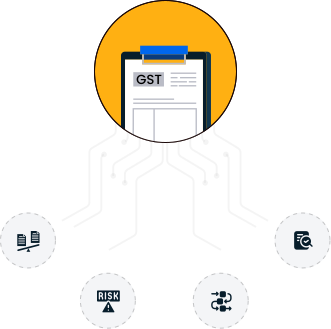
ITC Leakage Risk
Manual invoice matching increases the risk of missing eligible credits, accepting incorrect invoices, or failing to act on supplier-reported invoices before GSTR-2B finalization.
GSTR-3B Mismatch Exposure
When IMS actions are not aligned with GSTR-2B and GSTR-3B positions, businesses face reconciliation gaps, scrutiny, and potential reversals during GST review.
Time Lost in Spreadsheet Workflows
Manual IMS decisions often lack a clear user-level record of who accepted, rejected, or kept an invoice pending, making audit defense harder during departmental checks.
Weak Audit Trail
Manual IMS decisions often lack a clear user-level record of who accepted, rejected, or kept an invoice pending, making audit defense harder during departmental checks.
Reduce Manual Reconciliation Before It Impacts Your ITC
Automate invoice management system's Actions with GSTR-2B Reconciliation Buckets
Cygnet Tax IMS lets you set default or custom actions for every reconciliation bucket - so your ITC position is always accurate, intentional, and compliant.
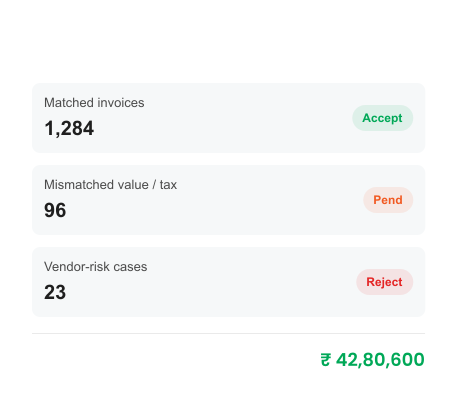
No Action
Demand as acceptance
Accepted
Records become part of GSTR-2B and GSTR-3B
Rejected
Records are included in the “ITC rejected” section of GSTR-2B
Pending
Defer decision for that.
Why Every GST-Registered Business Needs an Invoice Management System
GSTR-2B is no longer a passive statement. With an invoice management system (IMS), every supplier invoice requires a conscious action - Accept, Reject, or Pend. Businesses that skip IMS risk ITC reversals, GSTR-3B mismatches, and increased audit exposure. The GSTN has already begun factoring IMS behavior into compliance scoring.
Protect ITC Before Filing
An invoice management system in GST helps tax teams review supplier invoices before credits flow into the filing process, reducing the risk of excess claims, missed credits, and post-filing reversals.
Reduce GSTR-2B and Books Mismatches
Every invoice can be mapped against purchase register data and assigned the right action, improving alignment between vendor-reported data and internal books.
Create Decision Accountability
Accept, Reject, and Pend decisions can be tied to users, timestamps, reasons, and approval status, giving leadership a clear view of how ITC decisions are made.
Improve Audit Readiness
A structured IMS workflow creates a defensible compliance record by maintaining supporting documents, action history, and exception notes that can be accessed during GST audits.
Avoid Last-Minute Filing Pressure
Automated invoice management system’s alerts and bucket-based workflows help teams resolve invoice exceptions before filing deadlines instead of rushing through portal actions manually.
Key Features of our automated invoice management system
Automated IMS Action Management
Set rule-based or custom actions for invoices across Accept, Reject, and Pend workflows. This enables consistent invoice processing with less manual intervention.
GSTR-2B Reconciliation
Match supplier-reported invoices with purchase register data and identify value, tax, GSTIN, document number, and vendor mismatches. Exceptions can be routed for review before ITC is claimed.
Bucket-Based Decisioning
Group invoices into reconciliation buckets such as matched, mismatched, missing, duplicate, or vendor-risk cases. Each bucket can have a defined action logic, reviewer, and escalation path.
ITC Eligibility Controls
Flag invoices where ITC eligibility may be restricted, disputed, or dependent on vendor correction. This reduces the risk of claiming credit that may later need reversal.
Bulk Actions and Workflow Approvals
Enable bulk IMS actions for clean invoices while routing exceptions through approvals. This speeds up month-end compliance without losing control over high-risk cases.
Alerts and Exception Dashboard
Manage IMS and GSTR-2B workflows through GSTN-connected processes after internal validation. This keeps invoice actions aligned with GST portal requirements.
GSTN-Connected Compliance Workflow
Manage IMS and GSTR-2B workflows through GSTN-connected processes after internal validation. This keeps invoice actions aligned with GST portal requirements.
Audit Trail and Reports
Maintain user-level action history, comments, timestamps, and exportable reports for internal review, statutory audit, and departmental scrutiny.
See Automated IMS Actions and Reconciliation in Action
Integrate GST IMS with Your ERP and Compliance Stack
Cygnet Tax IMS can connect with your existing ERP, purchase register, vendor data, and GST workflows so invoice actions and reconciliation decisions stay aligned with your books.






Access Resources

IMS Under GST: The Key to Compliance, ITC Accuracy & Governance
The introduction of the IMS marks a significant step forward in enhancing GST compliance and streamlining reconciliation between suppliers and recipients

Common Errors in ISD Distribution and Their Impact on ITC Claims
Understand the most common ISD errors, their impact on ITC distribution, and how stronger controls, reconciliation, and automation can reduce GST risk.

What is an Invoice Management System under the GST
Read this blog to know everything about Invoice Management System, a vital feature in the GST framework.
Frequently asked questions
The Invoice Management System (IMS) is a GST framework that allows taxpayers to review supplier invoices before claiming Input Tax Credit (ITC). Businesses can accept, reject invoices reported by suppliers. It will enhance ITC accuracy and reconcile with GSTR-2B.
Hence, GST-registered businesses use IMS to process supplier invoices and make informed ITC decisions. IMS enhances reconciliation, reduces compliance risk, and increases filing accuracy. GST regulations should be reviewed by businesses for compliance.
IMS directly impacts your Input Tax Credit (ITC) in GSTR-2B. The actions you take in IMS such as Accept, Reject, or Keep Pending determine which invoices are reflected in your GSTR-2B for ITC claims, helping you claim only eligible credits while minimizing mismatches and compliance risks.
If you reject an invoice in IMS, it will not be considered for your ITC claim in GSTR-2B for that period. The supplier will also be able to view the rejection, allowing them to correct the invoice or resolve the discrepancy, helping ensure accurate GST compliance.
Cygnet Tax IMS dashboard in GST porta seamlessly integrates through secure APIs, enabling real-time synchronization of invoices and IMS actions. This allows businesses to review, accept, reject, or keep invoices pending directly from a single dashboard while ensuring GST compliance and accurate ITC reconciliation. This cuts down on manual work and improves compliance efficiency.
Cygnet Tax can be deployed in the quickest possible time, typically within a few days, depending on your organization’s size, ERP landscape, and integration requirements. Our streamlined implementation approach ensures minimal disruption to your existing GST compliance processes, enabling a smooth transition with rapid onboarding and faster time-to-value.