





























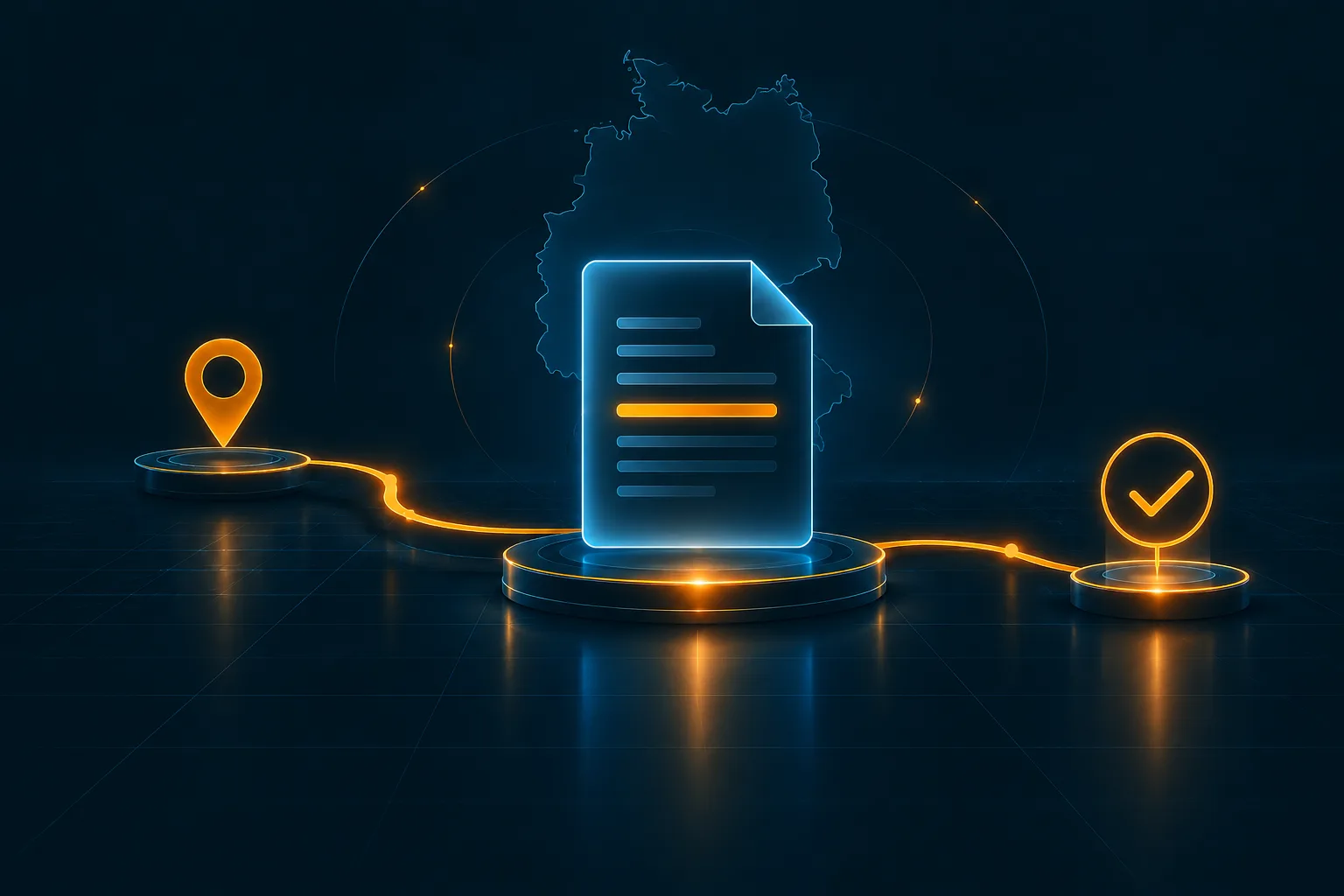
German government procurement authorities do not direct invoices by vendor name and mailing address; invoices are directed by the code. If an invoice is submitted electronically to a German federal ministry, state agency, or city government office, the invoice needs to be delivered to the correct office without manual re-entry or forwarding. This is the purpose of the Leitweg-ID.
Awareness of the code structure, placement in the document, and consequences of error will allow vendors to avoid the single greatest reason for Germany B2G e-invoicing rejection. This guide takes you through routing from the perspective of the vendor, including practical considerations for both accounting departments and service providers. Legal aspects are outlined in Germany’s structured invoice requirements, along with the phased rollout timeline and key compliance deadlines.
How the Leitweg-ID Works in German B2G Invoice Routing
The Leitweg-ID is the online address of a public billing recipient. This is to the electronic invoice what the street address and zip code are to a written letter, but in machine readable format. It is defined by the buyer; the supplier uses the ID verbatim in the invoice and all systems along the way use it to determine where the invoice goes.
There are many different public administration levels in Germany – the federal, the state, and the local level. Each level may consist of many different departments, budget units, and procurement departments. A simple business name or a VAT number cannot tell you which of those must be receiving the invoice. But the routing code can. It eliminates the guessing game and manual forwarding and allows the platform to forward the invoice to the right inbox immediately upon receipt.
The code consists of three segments, each separated by a hyphen:
- Level and body of government—coarse addressing. If it is a federal organization, it usually begins with “99,” while state and local organizations have different prefixes.
- Specific department/unit—fine addressing. This is an optional alphanumeric segment that specifies department or unit.
- Check digits. Two numeric digits, used for detecting typos prior to issuing the invoice.
A test value for a federal organization according to the supplier guidelines would be: 991-33333TEST-33.
Participants and Recipient Identifiers
Four entities play a role in every routed invoice:
- The supplier (the sender). Issues the invoice using their ERP or the services of an intermediary and stores the routing code of the buyer in the customer master data.
- The service provider or access point. Authenticates, converts, and transmits the file.
- The routing channel. Either a government portal, the dedicated e-mail address for e-invoicing, or the Peppol network.
- The public receiver. The agency that receives, verifies, and processes the invoice.
Identifiers are important throughout the process. The recipient routing code helps determine where to send the message. The VAT or tax number of the seller is used to identify the sender. The BT-13 purchase order number and BT-12 contract reference help the recipient link the invoice to an order. In the Peppol world, the recipient is identified using a participant ID based on a combination of the prefix 0204 and the routing code such as 0204:991-33333TEST-33. Consider the identifiers as master data; if each of these resides in one place in the ERP, all invoices will have the correct information.
This addressing approach is one of many global electronic invoicing models which separates the identity of the recipient from the invoice contents.
Sender-to-Receiver Routing
Routing is a short chain. The supplier obtains the code, builds a valid XRechnung, sends it through a channel and receives confirmation. TThis address-based delivery approach also aligns with Germany’s broader e-invoicing framework and the evolving European e-invoicing roadmap.
Discovery and lookup
The discovery process begins with the customer. The public entity assigns the supplier with its routing code when ordering or entering into an agreement, and the majority of the authorities display their codes on a page for invoicing data. Use the exact code provided by the customer, as different departments within the organization will have separate codes. Assign the code to the customer or agreement, not to the specific invoice.
On Peppol, the lookup process is automated. It involves the use of the participant ID to look up the recipient’s access point details. Nothing needs to be done manually, but participant IDs need to be constructed properly.
Delivery, acknowledgement and status handling
The way the submission is done relies on the channel used. In regards to the federal institutions, the invoice receipt platform known as OZG-RE offered by Bundesdruckerei has been the only way of submitting an invoice directly since September 2025. The suppliers have to fill in the invoice by themselves, upload an XRechnung, or send it via an email or Peppol.
In case of unsuccessful validation, the errors need to be rectified and the invoice re-submitted. Each of the Leitweg-ID invoices must have an audit trail within the systems of the suppliers, meaning the files sent, the channel used, the moment when it was sent and the status received.
XRechnung Leitweg-ID: Where to Place It and Required Fields
Routing is dependent on a few correct fields only. The XRechnung Leitweg-ID should be in the buyer reference field (BT-10), which is mandatory in XRechnung. In the UBL, this is the BuyerReference field in the document header, and in the CII, it resides in the header trade agreement block. The ID should be copied precisely with hyphens and check digits and without any spaces or additional information. As the recipient’s systems will automatically process these fields, the entry into a wrong field results in non-processing even if the value is correct.
Around this, you should provide the following fields necessary for matching and paying the invoice:
- Purchase order reference (BT-13), and in case of relevance—contract reference (BT-12);
- The VAT ID of the seller (BT-31) or the tax number (BT-32);
- Contact details of the seller—this is required by XRechnung;
- Payment terms (BT-20) and the payment account (BT-84).
The absence of master data is the main reason for troubles. Save your routing code, order reference rule and the preferred communication channel as separate fields in your customer record.
Recipient and Routing Failures
Most Germany e-Invoicing errors in routing are caused by incorrect data:
- Missing code. There is no BT-10 code, so the file fails validation and is rejected.
- Typing error. One digit or letter is incorrect, making the check digits invalid or indicating a different unit.
- Wrong unit. The code is valid, but it is for another unit that will delay the processing of the invoice.
- Outdated code. Authorities reorganize, and the code that was working last year is no longer active.
- Wrong participant ID. In the Peppol network, there is a missing 0204 prefix or a typing mistake that prevents delivery on lookup.
- Wrong channel. The invoice is delivered to an email that is not configured for receiving e-invoices.
A rejected invoice has not been delivered, and therefore it will not go through the approval and payment process of the buyer. Fix the data, send a new file, and negotiate with the buyer how the replacements or credit memos should be processed. Validate your files before delivering, always save the code in your contract, and assign someone to monitor rejections. Suppliers selling across different countries must also align their routing checks with the European VAT process and cross-border VAT compliance across the EU
Checks Before Choosing a Germany E-Invoicing Provider
Vendors who provide a Germany e-Invoicing solution should be able to answer these questions before live:
- Does it validate the routing code format and check digit before transmitting?
- Does it map BT-10 using ERP customer/contract data?
- Does it transmit via which channel—federal platform, Peppol, e-mail, or state portal?
- How does it handle status notifications, and how does it correlate them with the ERP document?
- How does it store validation results of each Leitweg-ID invoice in connection with the file?
- Who is notified in case an invoice is rejected, and how soon?
Test one invoice with a test routing code before going live and make sure to test at least one public customer per federal, state, and local level.
Conclusion
The Leitweg-ID is a critical component of Germany’s B2G e-Invoicing process, ensuring that electronic invoices reach the correct government department without manual intervention.
For businesses, getting Leitweg-ID compliance right requires more than generating a valid XRechnung. It calls for accurate ERP master data, automated validation, reliable transmission channels, and continuous monitoring of invoice acknowledgements and rejections. With a capable e-invoicing solution, businesses can streamline invoice routing, strengthen validation, and maintain better visibility across submission workflows, helping them manage Germany’s B2G e-invoicing requirements with greater confidence.
FAQ's
This is the routing identification number given by a public body so that the electronic invoice gets delivered to the right recipient. This ID comprises coarse addressing, optional fine addressing and check digits. The buyer supplies this information to the seller.
We use this ID when a German public sector entity receiving the XRechnung uses this number for routing purposes. BT-10 – buyer reference field, is an obligatory field in XRechnung and this ID is in this field for a public sector buyer. If the buyer provides you a code then use it.
It is in the Buyer reference field. In UBL it is cbc:BuyerReference and in CII it is ram:BuyerReference in the header trade agreement.
The public buyer. It is communicated along with the order or contract and usually listed on the authority’s invoicing page. The suppliers do not generate it themselves.
No value will cause a validation failure of the invoice. An erroneous value may lead to a failure of the check digit, incorrect delivery, or unrecognizability by the receiving system. Correct the data and re-send it, while making sure about the deadlines with the buyer, since the rejected invoice was never delivered.
Author


Kesha Shah
General Manager - Products Marketing
Kesha Kumar leads the global products marketing team at Cygnet.One, where she turns the complexity of tax and finance transformation into stories that resonate with the people who matter most. She’s the strategic force behind the brand’s presence across India, the GCC, Southeast Asia, and Europe, translating dense subjects like e-Invoicing mandates, digital engineering, and enterprise AI into narratives that inform and drive action. With expertise spanning tax and finance transformation, quality, enterprise applications, and data and AI, Kesha blends sharp strategic thinking with a marketer’s instinct for what truly connects. At Cygnet.One, she does more than build campaigns and content; she shapes the conversations that help enterprises navigate compliance with clarity and confidence, propelling the brand to the forefront of the industry along the way.