



































Shift-right testing is the practice of validating software behavior in production environments after deployment, using real data and live infrastructure conditions as the testing inputs.
Pre-production testing covers the scenarios a team anticipated and the data patterns a QA team scripted. Production testing covers everything else. After a data migration, specifically, that everything else is where the most significant risks live.
This blog covers the specific techniques for reliably validating migrated systems after go-live, and the framework that makes post-migration production validation repeatable.
What Is Shift-Right Testing in DevOps?
What is shift-right testing in DevOps in precise terms? It is the deliberate extension of testing activities into the production environment, using real user traffic, real data, and real infrastructure conditions as the validation inputs.
The “right” in shift-right refers to moving validation activities further right on the development timeline. Past staging, past UAT, and into the production phase, where conditions that no pre-production environment can fully replicate become visible.
Two things are true about shift-right testing simultaneously:
- It does not replace pre-production testing — pre-production testing catches functional failures, logic errors, and integration issues before users are ever affected
- It catches a different category of failure — the ones that only appear when real users interact with real data on live infrastructure at the same time
After migration, that second category is where the most significant risks live. A staging environment running a three-week-old copy of production data does not expose the failure modes that appear when real users hit a live system carrying years of production data complexity. Shift-right testing after migration is not optional for organizations that cannot tolerate post-go-live surprises.
What Do Pre-Production Tests Miss That Production Reveals?
Pre-production testing has structural limitations that are not solvable through better test planning. They are inherent to what a staging environment is.
Synthetic Data Versus Real Data Complexity
Pre-production test datasets are clean, curated, and representative of known data patterns. Production data accumulated over the years carries edge cases, encoding inconsistencies, deprecated field values, and data relationships that test datasets never contain.
Validating systems after migration with synthetic data produces confidence that disappears the moment real users interact with data combinations that the test suite never anticipated.
Simulated Load Versus Real User Behavior
Real users navigate systems in ways that scripts do not anticipate:
- They run concurrent sessions that scripts serialize
- They trigger unusual data combinations that no test plan documents
- They follow edge case workflows that emerge from real usage rather than designed journeys
The performance failures that load testing misses consistently appear within the first 48 hours of real user traffic on a newly migrated system.
Infrastructure Behavior Under Real Conditions
Cloud infrastructure behaves differently under sustained real traffic than under burst load testing sessions. Network latency, database connection pool exhaustion, and cache invalidation patterns all manifest differently under continuous real user load than under a controlled 30-minute load test.
These gaps are structural limitations of pre-production environments. Shift-right testing is designed specifically to close them after migration.
What Are the Core Shift-Right Testing Techniques for Post-Migration Validation?
Canary Releases
A canary release routes a small percentage of real user traffic to the newly migrated system — typically 1 to 5% — while the remaining traffic continues on the legacy system.
What canary releases validate that staging cannot:
- Performance degradation under real concurrent user load
- Data rendering failures on specific accounts or record types
- Integration breakdowns that only appear with live API dependencies
Shift-right testing through canary releases gives the migration team measurable evidence of system behavior before committing the full user population to the new environment.
Shadow Mode Testing
Shadow mode runs the migrated system in parallel with the legacy system using data migration services. Real user requests get processed by both systems simultaneously. The legacy system serves the actual response to the user. The migrated system processes the same request independently and its output gets compared against the legacy output automatically.
Shadow mode is particularly effective for validating systems after migration because it produces a direct, continuous comparison under identical real-world conditions. Discrepancies surface without any user ever experiencing a failure.
Feature Flags and Gradual Rollout
Feature flags enable specific functionality to be activated for defined user segments before the full user population experiences it.
Rollout sequence:
- Internal users first
- Small beta group second
- Progressively larger segments as validation confirms correct behavior at each stage
Production testing strategies built around feature flags give engineering teams precise control over which users experience which system behavior at every stage of the post-migration validation window.
Chaos Engineering
Chaos engineering deliberately introduces failures into the production environment to validate that the system handles them correctly.
After migration, chaos engineering specifically validates:
- Retry logic implemented correctly in the new architecture
- Circuit breakers functioning as designed
- Failover systems routing traffic as expected when a dependency fails
Post-deployment validation that skips resilience testing leaves an entire category of failure modes completely unverified before users encounter them.
What Monitoring Practices Support Shift-Right Testing After Migration?
Real User Monitoring
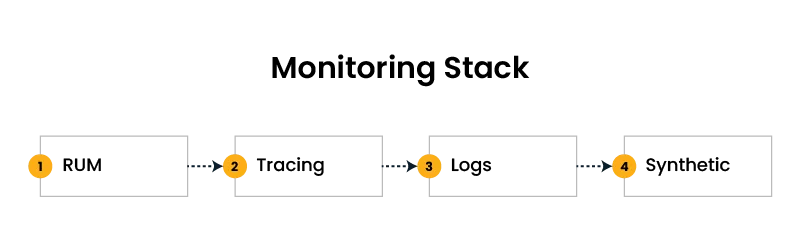
Real user monitoring testing strategies track actual user interactions with the production system in real time. Every page load, API call, and transaction gets measured for response time, error rate, and completion status as real users experience them.
Real user monitoring surfaces performance degradation that synthetic monitoring misses. It measures what real users actually experience rather than what scripted probes simulate. After migration, it provides the ground truth for whether the migrated system performs at the level the user population expects.
Distributed Tracing
Distributed tracing follows a request from the point of entry through every service, database call, and external dependency it touches. After migration, it identifies exactly which component in the new architecture is responsible for latency or errors that surface in production.
Monitoring Coverage Across All Layers
| Monitoring Type | What It Catches | When It Runs |
| Real user monitoring | Actual experience degradation | Continuously, real traffic |
| Synthetic monitoring | Availability failures, baseline latency | Continuous scripted probes |
| Distributed tracing | Root cause of specific failures | On every traced request |
| Log aggregation | Error patterns across services | Continuously, all environments |
What Does a Shift-Right Testing Framework Look Like After Migration?
Testing in Production Best Practices
Testing in production best practices follows a defined sequence after migration:
| Week | Activity | Validation Goal |
| Week 1 to 2 | Shadow mode alongside legacy system | Discrepancy rate below 0.5% |
| Week 2 to 4 | Canary release at 5% traffic | Error rate below 1.5%, SLA met |
| Week 4 to 6 | Traffic increased to 25% | Performance stable at higher load |
| Week 6 to 8 | Progressive rollout to 100% | Chaos engineering validates resilience |
Rollback Trigger Design
Every shift-right testing program requires defined rollback triggers before the first real user reaches the migrated system. Triggers are specific and measurable:
- Error rate exceeding 1.5% of requests triggers immediate rollback
- Response time exceeding SLA by more than 20% for 10 consecutive minutes triggers rollback
- Shadow mode discrepancy rate exceeding 0.5% triggers a pause and investigation before any traffic increase proceeds
Observability as a Testing Input
Observability data from production is testing input, not just monitoring output. Error rates, latency distributions, and user session completion rates from production all feed back into the validation framework and inform whether the migration has met its defined success criteria.
Post-deployment validation that treats observability as passive reporting rather than active testing input misses the feedback loop that makes shift-right testing operationally reliable.
Your Migration Is Not Done Until Production Is Validated
A migration that completes in staging is a migration that is halfway done. The second half is production testing strategies applied systematically after go-live. Canary releases, shadow mode, real user monitoring, chaos engineering, and defined rollback triggers all running as a connected validation program.
Cygnet.One’s data migration and modernization practice includes post-deployment validation as a defined deliverable within every migration engagement:
- Production validation is designed into the migration program from the planning phase
- Rollback triggers are defined before go-live, not after an incident
- Monitoring architecture is configured before the first real user reaches the migrated system
- Shadow mode comparison runs before any traffic is committed to the new environment
The result is a migration that does not end at go-live. It ends when production data confirms that the migrated system meets every performance, data integrity, and resilience requirement under real user conditions.
Organizations planning migrations that require post-go-live validation confidence can connect with Cygnet.One
FAQs
What is shift-right testing?
It is the practice of validating system behavior, performance, and data integrity in the production environment using real user traffic and real data rather than synthetic pre-production test conditions.
How is shift-right testing different from traditional QA?
Traditional QA validates system behavior before production using controlled test environments and synthetic data. Shift-right testing validates system behavior in production using real users, real data, and live infrastructure conditions that staging environments cannot replicate.
What is a canary release in shift-right testing?
A canary release routes a small percentage of real user traffic to the new system, while the rest stays on the legacy system. It validates production behavior under real conditions while limiting the number of users affected by any failures that surface.
When should rollback triggers be defined?
Before the first real user reaches the migrated system. Rollback triggers must be specific and measurable thresholds defined during migration planning, not configured reactively after a production incident occurs.
Is shift-right testing only relevant after migration?
No. It applies to any significant system change in production, including major releases, infrastructure changes, and architecture updates. Migration is the highest-risk context because it combines data complexity, infrastructure changes, and application behavior changes simultaneously.
Author


Yogita Jain
Content Lead
Yogita Jain leads with storytelling and Insightful content that connects with the audiences. She’s the voice behind the brand’s digital presence, translating complex tech like cloud modernization and enterprise AI into narratives that spark interest and drive action. With a diverse of experience across IT and digital transformation, Yogita blends strategic thinking with editorial craft, shaping content that’s sharp, relevant, and grounded in real business outcomes. At Cygnet, she’s not just building content pipelines; she’s building conversations that matter to clients, partners, and decision-makers alike.