




































Six months after a migration completes, engineering teams often find themselves spending more time maintaining the environment than building anything new. Cloud bills run higher than projected. Performance issues appear without obvious causes. Security reviews surface configurations that should have been addressed at go-live.
This is what cloud technical debt looks like in modern cloud environments. It is a steady accumulation of deferred decisions that compound quietly over time. This blog covers where that debt comes from, what it costs, and how structured remediation actually works.
What Is Cloud Technical Debt?
What is cloud technical debt in a post-migration context? It is the accumulated cost of architectural shortcuts, deferred refactoring work, and suboptimal configuration decisions made during a migration to meet delivery deadlines.
Much of it lives in application architecture, pipeline design, and configuration choices that were acceptable at migration speed but are not sustainable at production scale. Three things define it clearly:
- It is inherited by the operations team at go-live
- It grows through normal operations if left unaddressed
- It produces measurable cost, performance, and risk consequences over time
Every shortcut taken during migration becomes a debt item the operations team manages after the migration team has moved on.
How Does Cloud Technical Debt Differ From On-Premise Technical Debt?
On-premise technical debt accumulated slowly compared to modern cloud computing environments. In cloud environments, infrastructure changes are fast and cheap — which means debt accumulates at the same speed.
A misconfigured autoscaling policy, an unoptimized database query, or a monolithic application migrated without refactoring all generate ongoing cost and performance debt. On-premise, those issues were absorbed by fixed infrastructure costs. In cloud environments, they appear in monthly billing reports and accumulate with each billing cycle.
The speed that makes cloud migration attractive is the same speed that makes cloud modernization debt grow faster than most operations teams anticipate.
Why Does Cloud Technical Debt Accumulate So Quickly After Rapid Migration Programs?
Rapid migration programs prioritize one thing above everything else: moving workloads off legacy infrastructure within an aggressive timeline. Architectural quality is the variable that gets traded when that pressure increases.
Speed Over Architecture
Lift-and-shift migrations move applications without refactoring them for cloud-native operation, often requiring cloud modernization services. The application lands in the cloud running exactly as it ran on-premise, carrying all its original inefficiencies; now billing by the second.
The Post-Migration Handover Gap
Migration teams hand over to operations teams at go-live and move on to the next project. The operations team inherits an environment they did not design, running applications they did not refactor, on infrastructure configured under deadline pressure.
Post-migration cloud challenges begin the moment that handover happens without strong cloud governance. The debt is already embedded in the environment and the inheriting team rarely has a complete picture of what shortcuts were taken during the migration window.
Debt That Grows Through Normal Operations
Every change made to a system carrying technical debt adds complexity on top of existing complexity. A configuration change applied to an already suboptimal architecture produces results that are difficult to predict and harder to diagnose. Cloud modernization debt grows through normal operations.
What Does Cloud Technical Debt Actually Look Like in Production?
Debt manifests differently across different parts of the cloud environment. Recognizing the specific form it takes is the first step toward addressing it.
Architecture Debt
Applications migrated without refactoring run on cloud infrastructure without using cloud-native capabilities. They cannot auto scale effectively because they were designed for fixed on-premise capacity. They cannot use managed services because their data access patterns were built for local database connections. The result is an application paying cloud prices for on-premise performance.
Infrastructure Debt
| Debt Item | Description | Financial Impact |
| Oversized instances | Provisioned conservatively at go-live, never right-sized | Excess compute billing every month |
| Orphaned storage volumes | Attached during migration, no longer active | Ongoing billing with zero utilization |
| Unused security groups | Created during testing, never cleaned up | Governance and compliance risk |
Pipeline and Automation Debt
CI/CD pipelines built for migration speed carry fragile configurations that break unpredictably in production. Manual deployment steps included as temporary workarounds during migration become permanent processes because nobody schedules time to automate them after go-live.
Security and Compliance Debt
Access controls provisioned broadly during migration to avoid blocking progress never get tightened after the deadline passes. Encryption configurations deferred during migration because they would have slowed the timeline, representing ongoing compliance exposure that grows with every audit cycle.
What Does Unmanaged Cloud Technical Debt Cost an Enterprise?
In cloud environments, technical debt costs appear in monthly billing reports, but rarely get attributed to debt specifically.
The financial cost is the most visible consequence. Two others follow closely behind.
Operational cost is significant. Systems carrying architectural debt take longer to modify, longer to debug, and longer to scale than systems built on clean foundations. Engineering teams spend time managing symptoms rather than building new capabilities, and that opportunity cost never appears in a budget line.
Post migration cloud challenges create a longer-term talent problem as well. Engineers with strong cloud skills actively avoid environments where technical quality is consistently deprioritized. The debt retention problem compounds the debt technical problem.
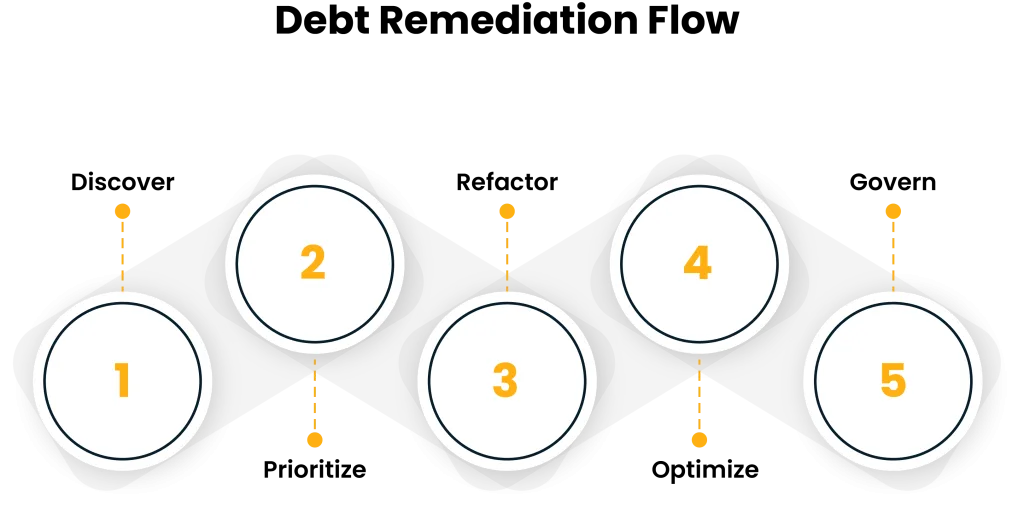
Managing technical debt in cloud systems that have accumulated over months requires a structured, sequenced approach. Reactive fixes applied one at a time do not reduce the overall debt load, they redistribute it.
What Post-Migration Refactoring Strategies Actually Reduce Cloud Technical Debt?
1. Debt Discovery and Categorization
Before any refactoring begins, every debt item in the environment gets identified and categorized. Discovery covers four specific areas:
- Architecture debt: Applications running lift-and-shift that should be refactored for cloud-native operation
- Infrastructure debt: Resources that are oversized, orphaned, or misconfigured
- Pipeline debt: Manual processes, fragile CI/CD configurations, and missing automation
- Security debt: Overly permissive access controls and missing encryption configurations
Each item gets classified by severity of business impact and effort required to resolve. That classification drives the cloud optimization backlog management process that follows.
2. Prioritized Backlog Management
A sequenced backlog addresses debt in business impact order rather than technical convenience order.
| Priority | Debt Type | Approach |
| High severity, low effort | Quick wins; orphaned resources, oversized instances | Address immediately |
| High severity, high effort | Architecture and security debt | Dedicated project with defined timeline |
| Low severity, any effort | Minor configuration issues | Rolling remediation cycle |
Post-migration refactoring strategies that aim to address all debt simultaneously result in incomplete remediation across too many areas. Sequenced backlog management produces complete remediation in priority order with measurable progress visible at every stage.
3. Application Refactoring for Cloud-Native Operation
Lift-and-shift applications get refactored in phases. The first phase identifies which cloud-native services replace current on-premise-style implementations. Monolithic components get identified and sequenced for decomposition into independent services.
Refactoring means restructuring the application to use managed databases, autoscaling groups, and event-driven architectures where usage patterns support it. It does not mean rewriting applications from scratch.
4. Infrastructure Right-Sizing and Cleanup
Every instance type gets reviewed against 90-day utilization data supported by cloud engineering services. Instances running below 30% average CPU utilization for 90 consecutive days get downsized to a more appropriate instance type. Storage volumes with no activity in 60 days get flagged for decommission.
Post migration refactoring strategies at the infrastructure layer produce immediate, measurable cost reduction without requiring application changes, making them the fastest way to demonstrate tangible progress against the debt backlog.
5. Security Posture Remediation
Access controls get reviewed against the principle of least privilege. Every permission that exceeds what the workload actually requires gets revoked. Encryption configurations deferred during migration get implemented in priority order, starting with data stores containing regulated or sensitive information.
Cloud technical debt at the security layer carries specific urgency. A security misconfiguration can become a compliance finding or an active incident. An oversized instance is purely a cost problem. Both matter, but they require different response timelines.
What Does Structured Debt Remediation Look Like in Practice?
One of Cygnet.One’s finance sector clients, a B2B solution provider serving CFO and executive-level officers across the USA, arrived with a specific set of post-migration challenges. Expense prediction and budget management workflows were fragmented across disconnected systems. Financial data was siloed. Reporting was manual and slow. The existing architecture could not support the multi-level delegation and approval workflows the business required at its operating scale.
The engagement started with understanding the business requirement precisely. Which processes needed to work? Which workflows need automation? Which data needed to be centralized before anything else could function correctly?
Cygnet.One built a centralized platform consolidating budget planning, execution tracking, contract management, and workforce tracking into a single environment. The platform included:
- Dynamic approval workflows with multi-level delegation rules
- Integration with ad-hoc reporting through JReports
- Role-specific KPI dashboards for executives, HR, and funding management teams
The outcomes were specific. A centralized platform replaced fragmented operations. Data reporting accuracy improved measurably. Requirement tracking accelerated across the organization. That result came from diagnosing the underlying architectural and process debt, sequencing the remediation correctly, and building toward a defined target state.
Why Do Enterprises Need a Structured Partner for Cloud Debt Remediation?
Internal teams managing cloud technical debt remediation face a structural problem. The team responsible for remediating debt is the same team responsible for keeping production systems running. Debt remediation competes with operational maintenance for the same engineering capacity, and operational maintenance wins every time because it is urgent and visible.
A structured partner brings dedicated remediation capacity that does not compete with operational priorities. It also brings diagnostic experience to identify debt that internal teams have normalized and stopped recognizing as such.
Managing technical debt in cloud systems as a connected engagement, covering discovery, prioritization, refactoring, right-sizing, and security remediation, produces results that disconnected internal efforts rarely achieve consistently.
Organizations carrying post-migration debt that is affecting performance, cost, or compliance can start that conversation directly with Cygnet.One for cloud migration services.
Address the Debt Before It Addresses You!
Cloud technical debt accumulated during rapid migration programs cannot be resolved through normal operations. It compounds through them. The discovery, categorization, and sequenced remediation of that debt is a defined, executable process.
The cost of addressing it now is significantly lower than the cost of addressing it after it has produced a performance incident, a compliance finding, or an engineering team too consumed by maintenance to build anything new.
Author


Yogita Jain
Content Lead
Yogita Jain leads with storytelling and Insightful content that connects with the audiences. She’s the voice behind the brand’s digital presence, translating complex tech like cloud modernization and enterprise AI into narratives that spark interest and drive action. With a diverse of experience across IT and digital transformation, Yogita blends strategic thinking with editorial craft, shaping content that’s sharp, relevant, and grounded in real business outcomes. At Cygnet, she’s not just building content pipelines; she’s building conversations that matter to clients, partners, and decision-makers alike.