








































What’s new

Global e-Invoicing

e-Invoicing compliance Timeline

Know More →

Global e-Invoicing

UAE e-Invoicing: The Complete Guide to Compliance and Future Readiness

Read More →

Cygnet Vendor Postbox

Types of Vendor Verification and When to Use Them

Read More →

Cygnet Vendor Postbox

Safeguard Your Business with Vendor Validation before Onboarding

Read More →

Cygnet BridgeFlow

Modernizing Dealer/Distributor & Customer Onboarding with BridgeFlow

Read More →

Cygnet BridgeFlow

Accelerate Vendor Onboarding with BridgeFlow

Read More →

Cygnet Bills

GST Filing 360°: GST, E-Invoicing, E-Way Bills & Annual Returns Made Simple

Read More →

Cygnet Bills

Why Manual Tax Determination Fails for High-Volume, Multi-Country Transactions

Read More →

Cygnet IRP

GST Filing 360°: GST, E-Invoicing, E-Way Bills & Annual Returns Made Simple

Read More →

Cygnet IRP

Key Features of an Invoice Management System Every Business Should Know

Read More →

Cygnature

Automating the Shipping Bill & Bill of Entry Invoice Operations for a Leading Construction Company

Read More →

Cygnature

From Manual to Massive: How Enterprises Are Automating Invoice Signing at Scale

Know More →

What’s new

Data Analytics & AI

AI-Powered Voice Assistant for Smarter Search Experiences

Explore More →

Data Analytics & AI

Cygnet.One’s GenAI Ideation Workshop

Know More →

Digital Engineering

Our Journey to CMMI Level 5 Appraisal for Development and Service Model

Read More →

Digital Engineering

Extend your team with vetted talent for cloud, data, and product work

Explore More →

Quality Engineering

Enterprise Application Testing Services: What to Expect

Read More →

Quality Engineering

Future-Proof Your Enterprise with AI-First Quality Engineering

Read More →

Cloud Engineering

Cloud Modernization Enabled HDFC to Cut Storage Costs & Recovery Time

Know More →

Cloud Engineering

Cloud-Native Scalability & Release Agility for a Leading AMC

Know More →

Managed IT Services

AWS workload optimization & cost management for sustainable growth

Know More →

Managed IT Services

Cloud Cost Optimization Strategies for 2026: Best Practices to Follow

Read More →

Amazon Web Services

Cygnet.One’s GenAI Ideation Workshop

Explore More →

Amazon Web Services

Practical Approaches to Migration with AWS: A Cygnet.One Guide

Know More →

Cygnet TaxAssurance

Tax Governance Frameworks for Enterprises

Read More →

Cygnet TaxAssurance

Cygnet Launches TaxAssurance: A Step Towards Certainty in Tax Management

Read More →

Cygnet TaxAssurance

10 Generative AI Use Cases Driving Enterprise Value

Read More →

Cygnet TaxAssurance

Navigating the Generative AI Landscape

Read More →

Cygnet TaxAssurance

Truly Rise with SAP: The Business Integrators Guide

Read More →

Cygnet TaxAssurance

Mastering SAP S/4HANA Migration: Essential Pre-Migration Strategies and Preparation

Read More →

Agentic SDLC Platform for Governed Software Delivery

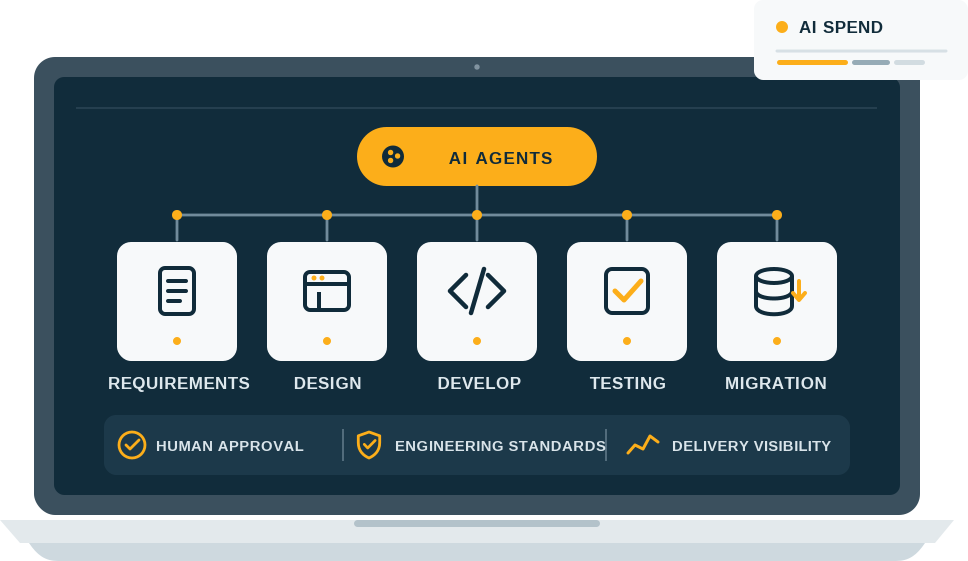
Coordinate AI agents across requirements, design, development, testing, and migration through one platform, with human approvals, engineering standards, delivery visibility, and measurable AI spend.

CMMI ML5 Appraised
ISO 27001:2022 Certified Company

risk-banner

One Platform for AI-Led Software Engineering

Disconnected workflows, repeated handoffs, and inconsistent engineering practices can slow software delivery. Enterprises need an AI-driven approach that maintains context, quality, and control across the development lifecycle.

Cygnet.One’s Agentic SDLC Platform brings specialized AI agents, enterprise knowledge, and engineering workflows into one environment. Teams can configure agents, coordinate work through Jira, enforce human approval checkpoints, and monitor delivery progress, AI spend, and estimated ROI across projects.

What Agentic SDLC Means for Your Team

Engineering, product, and business leaders face different challenges in software delivery. Cygnet.One brings their workflows, decisions, and performance measures into one governed platform, helping teams work with greater consistency, visibility, and accountability.

For Engineering Leaders

Maintain engineering consistency as AI adoption grows. Apply approved architecture rules, coding standards, and quality controls across agent-assisted workflows, with human reviews at defined checkpoints.

For Product and Delivery Leaders

Keep requirements, development, and testing connected. Track feature progress, identify approval bottlenecks, and maintain clear ownership from requirement drafting through UAT sign-off.

For Business and Finance Leaders

Connect AI investments to measurable delivery value. Track model spending, agent activity, estimated hours saved, and calculated ROI across projects to support informed investment decisions.

Specialized AI Agents Across the Software Development Lifecycle

01
Requirements Engineering

Refine Jira stories using product history, approved templates, acceptance criteria, and complexity-based requirements. Human reviewers approve changes.

Requirements Engineering
02
UI Prototyping

Create HTML prototypes and UI designs using approved components, layouts, and design conventions, with UI/UX review checkpoints.

UI Prototyping
03
Front-End and Back-End Development

Generate UI components and frontend code aligned with established application patterns and engineering standards.

 Front-End and Back-End Development
04
Backend Development

Support API development, database schemas, and backend implementation using approved architecture and coding conventions.

 Backend Development
05
QA and Test Generation

Generate test cases and scripts, and support API, UI, and regression testing against defined requirements.

QA and Test Generation
06
Enterprise Knowledge Management

Build and maintain an indexed knowledge base using product documentation, Jira history, architecture, and engineering artifacts.

Enterprise Knowledge Management
07
Legacy Migration

Support defined migration and modernization tasks using existing application knowledge and approved technical constraints.

Legacy Migration

How Our AI Software Development Lifecycle Works

01

Requirement Drafting

A requirement agent uses project history and defined templates to prepare or refine Jira stories, including acceptance criteria and supporting context for review.

02

Review and Approval

Analysts and product owners assess the proposed requirement. Approval becomes a recorded workflow step before subsequent work proceeds.

03

Design and Solutioning

UI and solution work draw on approved requirements, design patterns, and architecture constraints. Reviewers can inspect artifacts before development begins.

04

Development

Front-end and back-end agents work against the defined task and project standards. Engineering teams validate changes and manage repository workflows.

05

QA and Testing

Test-related work refers back to accepted requirements. Defects, coverage gaps, and changes requiring human review remain visible throughout delivery.

06

UAT Sign-off

Authorized stakeholders review acceptance evidence and decide whether the feature meets business expectations. The system records the sign-off.

Inside the Cygnet.One Agentic SDLC Platform

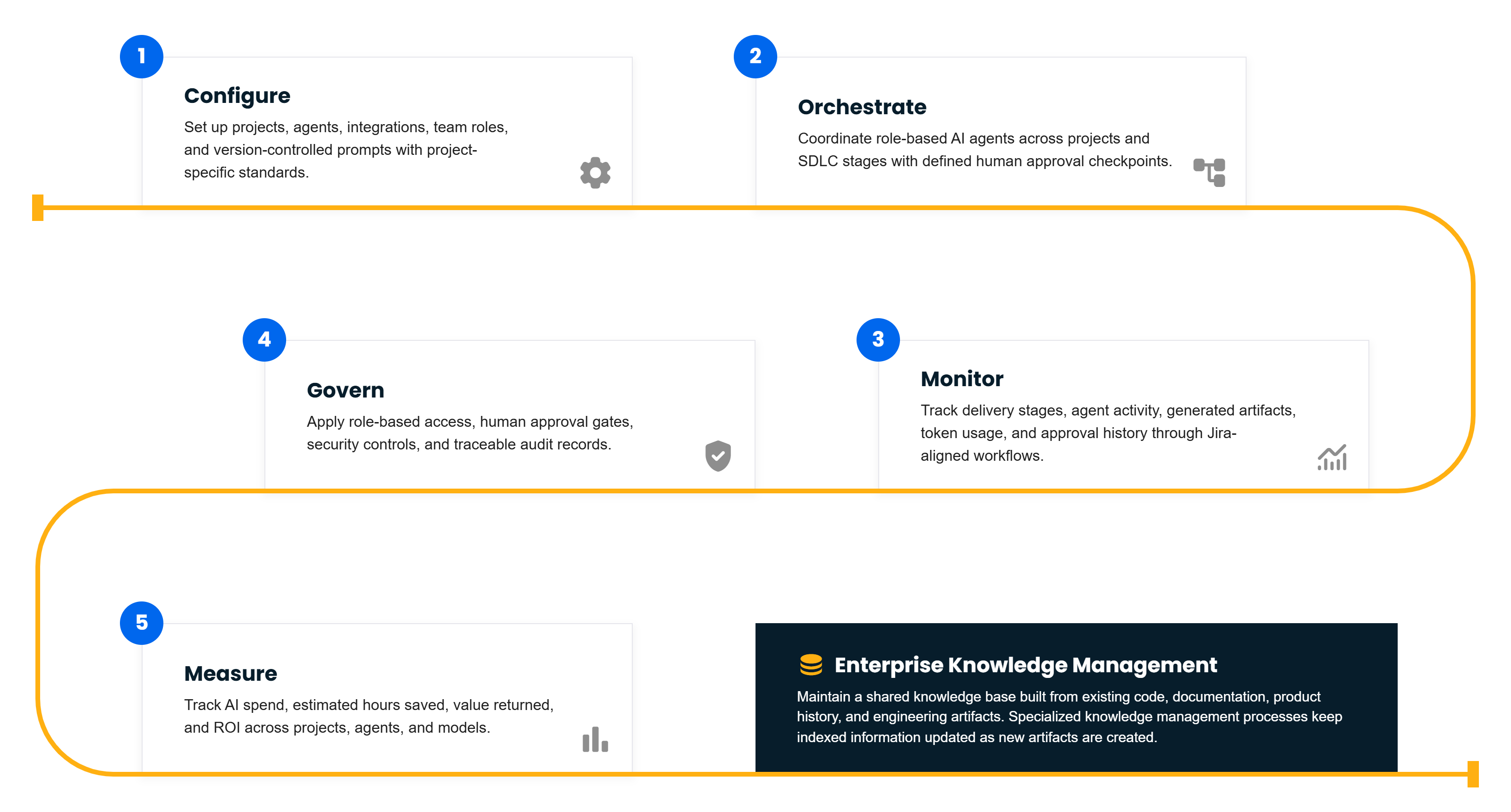
Agentic SDLC Platform Diagram

Developed Through Cygnet.One's Enterprise Engineering Experience

Cygnet.One has operationalized specialized SDLC agents using 7–8 years of product history and more than 7,000 Jira stories across three enterprise products: Cygnet e-Invoicing, GSP, and Tax Compliance.

This implementation experience helped refine the platform’s approach to requirements engineering, knowledge management, architecture-aligned generation, and human approval workflows.

Key Learnings from Internal Implementation:

  • Complexity-Based Requirement Templates
  • Standardized Requirement Documentation
  • Section-Level Editing
  • Architecture-Aligned Code Generation
  • Controlled External Knowledge Integration
api

Our Phased Agentic SDLC Adoption Approach

Readiness Assessment

Assess engineering maturity, delivery workflows, tools, knowledge sources, governance needs, and current delivery metrics to identify suitable opportunities for agentic adoption.

Single-Agent Pilot

Configure one agent with enterprise knowledge, approved templates, and human review checkpoints. Evaluate output quality, effort saved, and adoption before expanding.

Lifecycle Expansion

Introduce additional development, code review, QA, and DevOps agents in phases, with engineering standards, governance controls, and performance monitoring maintained throughout.

What You Gain with Cygnet.One

  • Reduced Manual Effort Across the SDLC
  • System-Enforced Governance and Approvals
  • Jira-Native Agent and Workflow Coordination
  • AI Accessibility for Non-Development Teams
  • Flexible AI Model and Provider Selection
  • Transparent AI Usage and Cost Tracking
  • Portfolio-Level ROI and Productivity Insights

Governance and Performance Controls for AI-Driven Software Development

AI output needs the same acceptance standards as human work. The platform makes those controls visible and traceable.

Governance checklist

  • Named project owners and approval stages
  • Role-based user and workflow permissions
  • Human approval for critical transitions
  • Project-specific engineering and architecture rules
  • Approved story templates and acceptance criteria
  • Version-controlled agent prompts
  • Managed enterprise knowledge and refresh cycles
  • Security and data-protection policies
  • Audit trails for agent activity, artifacts, and approvals
  • Usage, cost, and performance monitoring

Success measures

KPI What to monitor
Delivery speed Requirement-to-development time and cycle time
Productivity Effort saved on repeatable activities, checked against actual work
Quality Documentation consistency and test coverage
ROI Estimated value from hours saved at configured role rates, compared with actual AI provider spend.

Where Agentic SDLC Can Be Applied

BFSI: Apply governed workflows to requirements, code and testing where traceable changes, defined access and documented approvals carry operational importance.

Tax and GovTech: Maintain product and regulatory context across requirement changes, with controlled research sources and review of policy-sensitive outputs.

Manufacturing: Coordinate change requests across business applications and integrations while keeping system dependencies, technical conventions and approvals visible to delivery teams.

ISV and SaaS: Use shared product history and coding standards across releases.

background image

Frequently Asked Questions

Specialized AI agents handle defined work across requirements, design, development and testing. Teams supply project knowledge and operating rules. Human reviewers approve outputs and release decisions, with activity recorded in a shared workflow. This connects artifacts, reviewers and decisions between stages.

AI software development services support user stories, prototypes, code and testing. Reliable results require useful source context, engineering standards and human review. Cygnet.One connects these activities to project workflows so outputs, ownership and approvals remain traceable. Each task retains a clear owner.

AI in software development can draft requirements, summarize product knowledge, prepare prototypes, generate code and support testing. Teams assess outputs against business context, architecture, security rules and acceptance criteria before accepting changes. Sensitive outputs warrant additional engineering and business review.

Cygnet.One’s Agentic SDLC Platform coordinates AI agents across requirements, design, development, testing, and migration. It brings agent orchestration, enterprise knowledge, human approvals, delivery tracking, and ROI measurement into one environment. Teams can work through Jira-aligned workflows, with project-level configuration and governance extending beyond code generation.

Across the AI software development lifecycle, agents can assist with requirements, prototypes, code, tests, knowledge indexing and selected migrations. The scope of SDLC automation depends on requirements quality, integrations and safeguards. People retain authority over business approval, engineering acceptance and UAT sign-off. Automation follows defined permissions.

Reviewers are assigned to defined workflow stages. Role-based permissions control who can approve progression. Jira history, artifacts and audit trails show what agents produced, what changed and who authorized the next stage. Rejected outputs return for revision and subsequent approval.

The platform supports leading AI model providers, including Anthropic Claude, OpenAI, and Google Gemini, alongside local models and private endpoints. Deployment options, model compatibility, data residency, and infrastructure requirements are assessed during solution design.

The control tower records spend by model, agent and project. Estimated value comes from saved hours multiplied by configured role rates, compared with provider spending. Cycle-time and quality improvements should be assessed separately against a baseline. Reports distinguish estimates from observed results.

Begin with a readiness assessment covering workflows, ownership, engineering standards and project knowledge. Pilot one measurable task with a human approval gate. Review output quality and effort saved before introducing further agents or projects. Use the same baseline measures for comparison.

Ready to Put Agentic SDLC to Work?

Identify the right starting point for AI-assisted delivery. Assess your current workflows, engineering standards, enterprise knowledge, and governance requirements with Cygnet.One.