




















Enterprises rely on cloud environments to run critical applications, store business data, support automation, and manage customer activity across regions. These environments expand as teams deploy new services and add capacity to meet business needs, and this creates operational complexity. The growing complexity increases the need for structured oversight, so systems remain reliable and predictable. This is where cloud infrastructure management becomes essential. It helps teams establish control over compute usage, storage behavior, network activity, access rules, and operational signals that guide long-term stability.
A modern cloud environment functions across multiple layers, and each layer carries its own responsibilities. Applications operate inside distributed services, and data moves through storage and retrieval systems. Network paths connect these services across different regions. Each layer requires coordinated attention, so the entire environment stays stable during daily activity.
As workloads grow and shift, enterprises depend on monitoring systems, scaling frameworks, and compliance routines to maintain consistent behavior. These responsibilities shape the foundation of daily cloud operations and help teams manage environments with confidence.
What is cloud infrastructure management?
Cloud infrastructure includes all the components that support applications inside the cloud. These components include:
- Compute instances
- Storage layers
- Network paths
- Service endpoints
- Automation frameworks
Managing these components requires a structured process that determines how resources are created, maintained, and monitored — a foundation strongly supported through our cloud engineering services, which help enterprises design secure and scalable environments. This structure forms the base of what is cloud infrastructure management, and it supports steady performance across all environments.
A cloud setup contains many elements that interact continuously. Each application depends on resources that need careful attention, and this creates several responsibilities for teams. Some of the key areas include:
Workload tracking: Teams observe how activity changes during the day, so they know when resources need adjustment.
Storage behavior: Growth patterns show how data is being used and where capacity needs to increase.
Service communication: Interactions between services reveal how different layers depend on one another.
Operational monitoring: Tools capture logs, events, and performance signals that help teams understand real traffic behavior.
Scaling routines: Capacity increases or decreases in response to activity, which keeps applications responsive.
Compliance checks: Access rules and configuration standards to keep environments safe and predictable.
These responsibilities require clear processes, so teams can remain consistent in how they manage the environment. Enterprises rely on this consistency to avoid unexpected behavior and maintain dependable systems. This is why cloud infrastructure management remains a central discipline for organizations that operate in the cloud.
What does cloud infrastructure management include in modern enterprises?
Cloud environments require steady oversight across several operational areas, and each area contributes to overall stability. These areas work together to provide visibility, control, and predictable system behavior as workloads change — especially when supported through cloud operations and optimization services that streamline compute governance, storage lifecycle rules, and network routing decisions.
Compute responsibilities
Compute instances handle the execution of services and jobs. Teams select instance types that match the workload and determine how many instances should run at any given time. Autoscaling rules respond to traffic patterns and adjust the number of active instances. These responsibilities help maintain responsiveness and ensure performance aligns with user activity.
Storage responsibilities
Storage systems hold files, datasets, backups, and operational outputs. Teams manage access patterns so different applications can retrieve data safely. Retention policies define how long data remains stored. Performance levels vary across storage tiers, and teams select these tiers according to how the data is used. These decisions shape the speed and reliability of data access.
Network responsibilities
Network paths allow services to communicate. Routing rules determine how requests move across regions. Teams monitor latency and connectivity to ensure applications respond consistently. When these paths operate smoothly, system behavior remains stable.
Service oversight
Services inside the cloud environment require identity rules and access boundaries. Teams maintain version details to avoid confusion during updates or incident handling. Clear ownership structures prevent overlaps and help teams respond quickly when issues arise.
Monitoring as a continuous requirement
Monitoring supports all other responsibilities. Logs, metrics, and events show how resources behave under real workloads. Teams use these signals to detect changes in performance and identify areas that need attention. Alerting routines notify teams when behavior moves outside expected ranges. These signals help maintain predictable operations and stronger system visibility.
Organizations that use cloud infrastructure management services receive structured workflows for provisioning, monitoring, governance, scaling, and compliance management across cloud environments. These services help teams form structured processes that support stable environments. Many enterprises also depend on routines for audits and policy checks, and these routines create a predictable operational rhythm that strengthens long-term management.
How do enterprises monitor cloud infrastructure effectively?
Monitoring helps teams understand how cloud environments behave throughout the day. These environments produce continuous operational data that reflects system health, and observability platforms collect this data so teams can make informed decisions.
Effective monitoring captures activity across multiple layers. Several cloud observability and monitoring practices discussed here help teams maintain secure and predictable cloud-native environments.
Metrics show resource usage patterns such as CPU load or memory activity. Logs collect system messages that reveal internal behavior. Traces show how requests move across services. Alerts notify teams when values move outside healthy ranges. Together, these elements help teams respond to busy periods and maintain control during unexpected changes.
Monitoring also guides scaling decisions. When traffic increases, metrics reveal the need for additional capacity. When activity decreases, teams understand when it is safe to scale down resources. Monitoring also supports compliance routines because it captures events, configuration changes, and policy actions.
Here is a table that shows how monitoring contributes to operational stability:
| Area | What Is Monitored | Why It Matters |
| Compute | CPU, memory, load | Stable performance |
| Storage | Capacity, IOPS | Reliable data access |
| Network | Latency, routes | Predictable traffic flow |
| Services | Errors, requests | Clear operational patterns |
| Security | Access activity | Compliance readiness |
Teams practicing cloud infrastructure management depend on monitoring every day. It forms a connection between engineering activity and business expectations by showing how the environment responds to real workloads.
What enterprise benefits come from effective cloud infrastructure management?
Enterprises gain several advantages when cloud operations follow consistent management practices. These advantages shape how teams maintain systems, plan workloads, and strengthen internal processes.
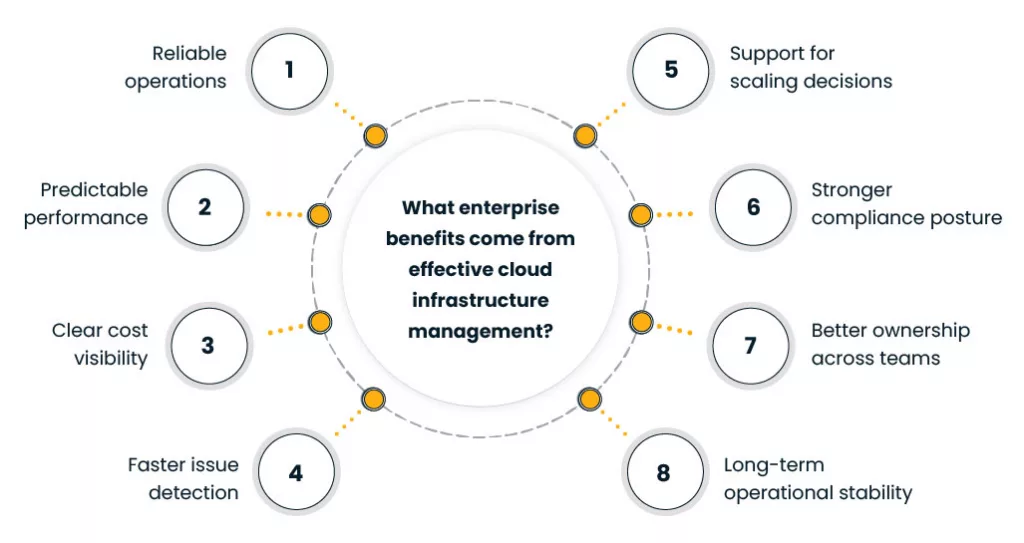
Reliable operations
A consistent management structure keeps systems steady even during high-traffic periods, especially when supported through cloud-native development services, which integrate security, scalability, and operational consistency from the start. Teams understand how resources behave, and this helps them prevent issues before they reach users.
Predictable performance
Monitoring, planning, and access controls help applications maintain predictable behavior. These routines reveal performance shifts early and allow teams to adjust configurations in a structured way.
Clear cost visibility
Enterprises gain clearer insight into resource usage when provisioning and tracking follow defined standards. This visibility supports financial planning and provides a better understanding of monthly trends.
Faster issue detection
Operational signals help teams identify unusual activity early. Logs and traces reveal the parts of the system involved, and this shortens investigation time, so teams maintain steady daily operations.
Support for scaling decisions
Systems that rely on structured management practices can scale more predictably. As workloads grow, teams understand when additional capacity is needed and how to apply it without disruption.
Stronger compliance posture
Defined identity rules and configuration standards support compliance requirements, further reinforced by cloud security best practices that reduce risk across distributed services. Teams maintain audit-ready environments because process consistency keeps systems aligned with regulatory expectations.
Better ownership across teams
Ownership models help teams understand which resources fall under their responsibility. This improves coordination and supports broader management of cloud infrastructure and services.
Long-term operational stability
Environments built on consistent routines adapt more smoothly as workloads change. This stability supports product development and internal growth across teams.
Key Takeaways!
Enterprises depend on cloud platforms to run applications, manage data, and support daily operations. These responsibilities require structured processes across compute, storage, network behavior, and monitoring. A consistent approach to cloud infrastructure management helps teams maintain reliable systems, respond to traffic changes, and prepare for compliance requirements. These practices support long-term stability and provide clarity across the entire cloud environment.
FAQs
Yes. Dedicated roles help maintain ownership and reduce operational confusion.
Yes. Monitoring signals reveal unusual patterns before they affect users.
Yes. Regular checks help maintain safe access and consistent configuration.
Yes. Workloads often require different capacity plans based on activity.
Yes. Stability depends on transparent processes, ownership, and consistent monitoring.
Author


Abhishek Nandan
AVP, Marketing
Abhishek Nandan is the AVP of Services Marketing at Cygnet.One, where he drives global marketing strategy and execution. With nearly a decade of experience across growth hacking, digital, and performance marketing, he has built high-impact teams, delivered measurable pipeline growth, and strengthened partner ecosystems. Abhishek is known for his data-driven approach, deep expertise in marketing automation, and passion for mentoring the next generation of marketers.