




































Any decision you take at the beginning of a project defines the next steps you will have to take. A well-defined project plan acts as a development guide that fulfills your current requirements and allows you to make necessary changes when and where needed. This project plan that takes architectural characteristics into consideration and is based on architectural design principles forms the architectural design.
Building the Foundation: The Crucial Role of Architectural Design
Architecture constitutes the strategic organization and relationships of the components of a system with each other and with the environment, based on the principles that govern its design and evolution. Architectural design is designing a system or project’s overall structure, organization, and functionality. Architectural design characteristics include the features and functional and non-functional requirements that bridge an application’s technical and business aspects.
Key Benefits of Architectural Design for Your Application
- Create a blueprint or plan for the system that ensures it will meet its intended goals and objectives.
- Ensure the system is efficient, reliable, maintainable, and scalable while adapting to changing requirements.
- Consider factors such as security, performance, usability, and accessibility, to ensure that the system will be usable and accessible to all users.
- Plan during the early stages of decision-making
- Ensure that the system will be aligned with the overall business strategy and goals of the organization.
- Enable implementation of future changes and adjustments in response to external demands and trends.
- Understand the potential of new technology initiatives and capabilities, and determine how your organization can use these to its advantage.
- Ensure that solutions support the achievement of the business strategy and objectives.
- Fix the challenges in solution-delivery projects.
- Differentiate the organization and enable it to achieve operational and competitive advantage.
- Ensure that value flows through the organization to the customers/users
- Provide a common language and understanding for all stakeholders involved in the project, helping to ensure effective communication and collaboration throughout the development process
- Enable flexibility to add/append the third-party integration and system/application/software expansion and upgradation.
Architectural Design Principles
Just as a strong foundation is essential to raise a secure building, a properly designed architecture of your application/software can save many resources later. A few principles are helpful when planning the architectural design:
- Address the core requirements by mapping them to the organizational structures and avoiding scope creep but keeping scalability in mind.
- Be flexible in your approach initially and fixate on it only after you clearly understand your future feature requirements.
- Be open to deleting and iterating your architectural design, as the first version may require rework.
- Create an execution plan with realistic time estimates.
- Prioritize the reusability of everything, right from software libraries to container images.
Defining the Blueprint: Architectural Design Characteristics
If your architecture produces stable and efficient systems, you can focus on other design aspects, such as functional architecture design. You may like to use the above basic principles and our checklist of characteristics that would help you create an outstanding architectural design.
These architectural characteristics are broadly classified as follows:
- Creational – Availability, Scalability, Durability, Operational prowess
- Structural – Resiliency, Agility, Usability, Extensibility, Sustainability
- Behavioral – Security, Reliability, Consistency, Observability, Cost optimization, Predictability
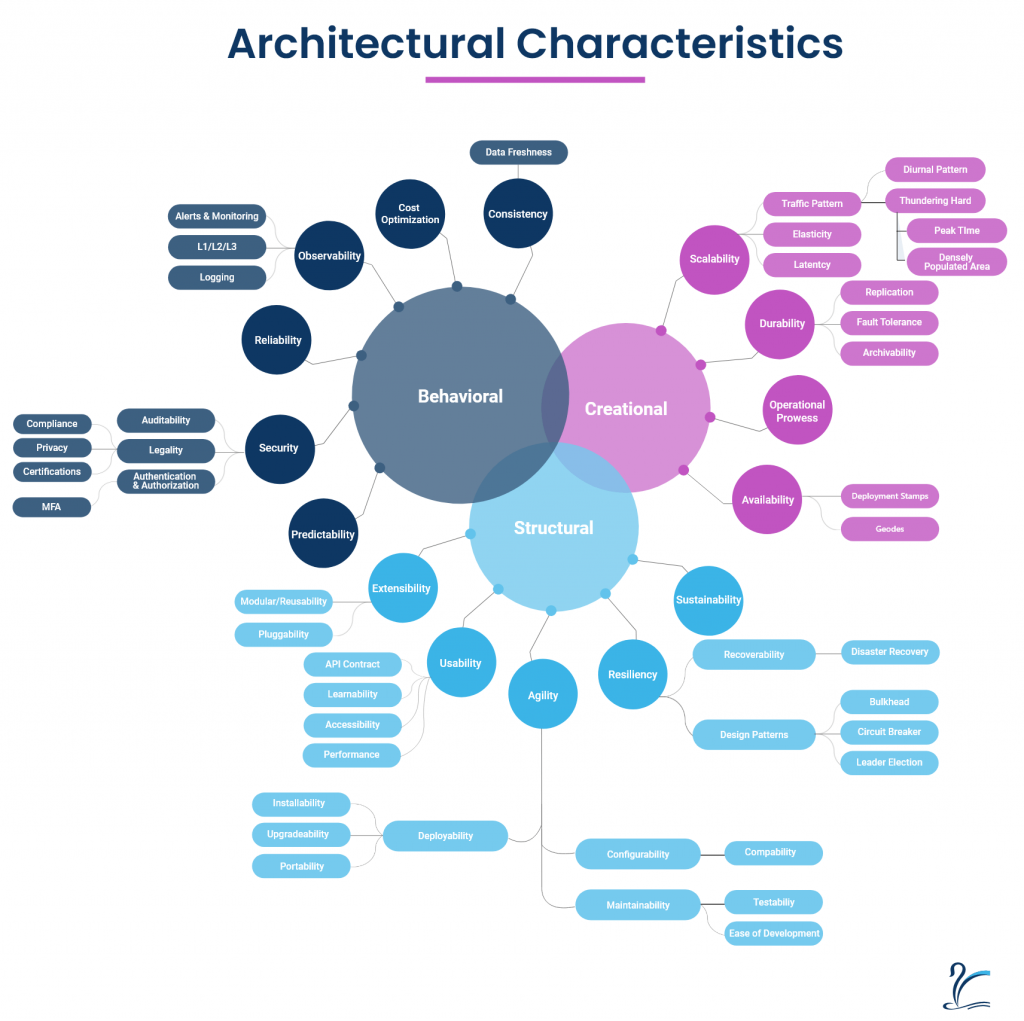
Creational Architectural Characteristics
Creational architectural characteristics refer to the features and traits that define how objects and classes are created and instantiated within a software system. These characteristics play a vital role in shaping the overall architecture of the software and significantly impact its availability, scalability, durability, and operational prowess.
By incorporating these creational architectural design characteristics into software development, developers can create more available, scalable, durable, and operational systems while adhering to best practices and design principles.
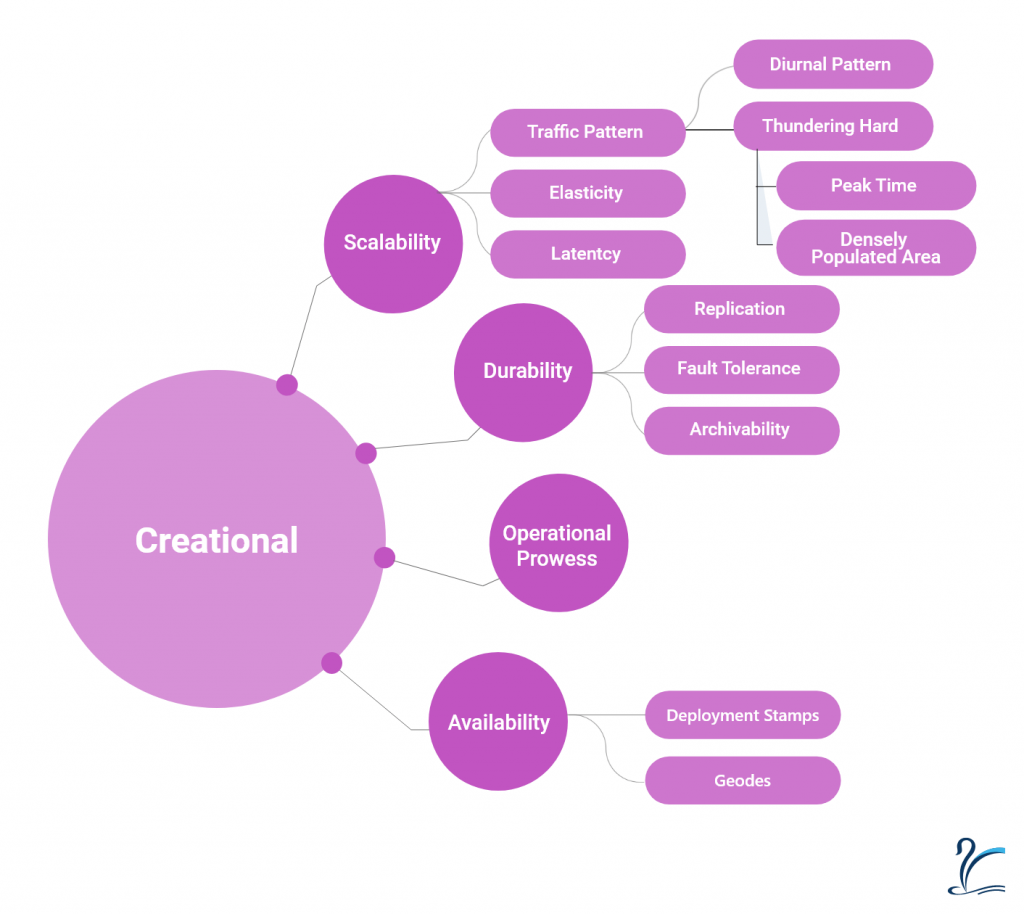
Availability
The application/software/system must be up and running most of the time to be productive. The system load and errors, infrastructure issues, and malicious attacks determine the availability.
- Deployment Stamps: It is advisable to deploy multiple, small, replicable independent units to host, operate, and scale large, distributed workloads or tenants and heterogenous groups of resources.
- Geodes: To increase availability, improve latency, and serve requests actively by distributing request processing around the globe, you should deploy a collection of backend services into a set of geographical nodes, each of which can provide service for any request of any client in any area.
Scalability
Planning for the present and future is essential for sustainable architectural design. While ideal architecture design standards meet the initial project requirements, they can scale up or down to adapt to any changing needs that may arise later in terms of users or requests.
A “Thundering Herd”- like situation occurs when there is a burst of traffic, with many users requesting resources but only a few available during peak time or in densely populated areas. Modern architectural design includes scalability that provides the ability to perform and operate with horizontal or vertical scaling to match the traffic patterns that have diurnal and/or global/regional variations.
- Elasticity: The architectural design should be able to quickly arrange the resources for handling increased traffic and gracefully shrink when the demand decreases.
- Latency: An efficient application needs to perform fast to decrease the revisit of the request. This is achieved by optimizing the algorithms and serving the request as quickly as possible to enhance the system’s latency.
Durability
An application is a long-term investment for any business. It should be able to meet the users’ needs for a relatively long duration and be serviceable to maintain consistency and efficiency.
- Replication: Sharing information and ensuring consistency between redundant resources is essential. This increases reliability, fault tolerance, or availability.
- Fault Tolerance: The architecture should be designed in such a way that it can easily accommodate one or more faults/failures within some of its components and still continue operating correctly.
- Archivability: Innovative architectural design needs to consider whether any data needs to be marked as obsolete, deleted, or archived in a secondary database after some time for future access.
Operational Prowess
The architectural framework should focus on executing and monitoring systems and constantly refining processes and procedures. This is achieved by making frequent, small, reversible changes, anticipating failures, and learning from all operational shortcomings.
Understanding the business and customer needs is vital to support business outcomes. Operations validate the effectiveness of the procedures and processes. With the changing business context, priorities, and customer demands, a business must evolve over time and incorporate the lessons learned through performance monitoring. The application architecture should automate changes, respond to events, and specify criteria to handle daily operations.
Structural Architectural Characteristics
Structural characteristics of the architecture focus on how different components, modules, and classes in a software system are organized and interconnected. These characteristics play a crucial role in shaping the overall architecture of the software, determining how components communicate and interact with each other.
By incorporating these structural characteristics of the architecture into software development, architects and developers can create systems that are resilient, agile, usable, sustainable, and easy to extend or modify as requirements evolve.
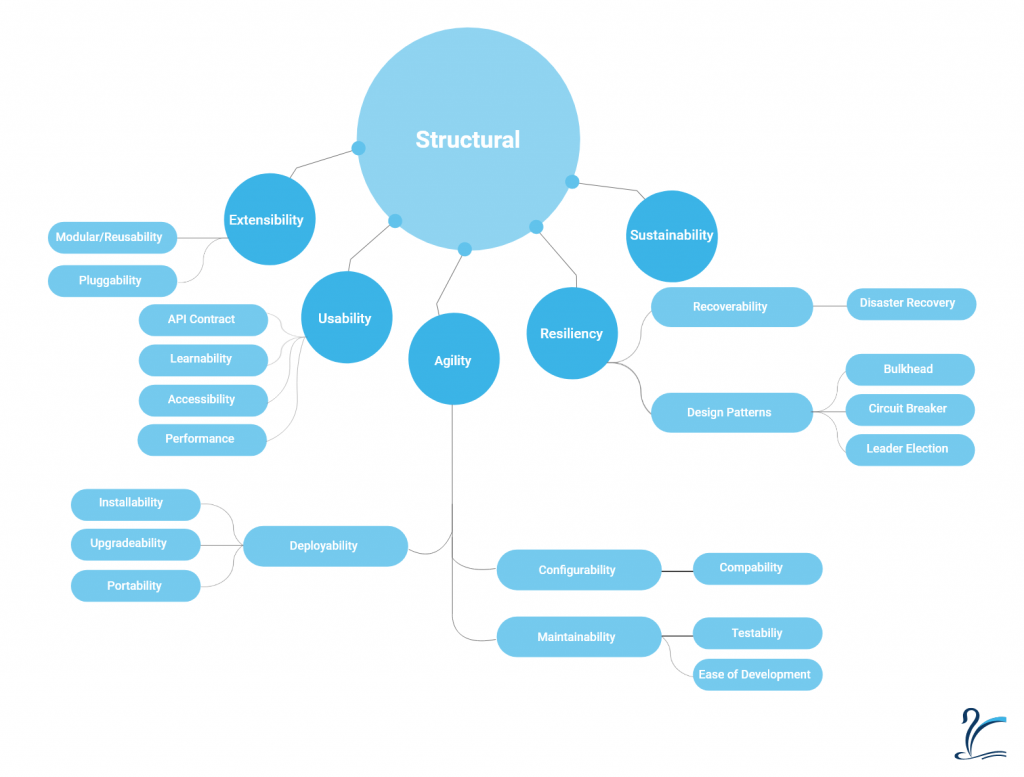
Resiliency
Any resilient design that can endure small-scale failures and large-scale disasters is a sure-shot mark of the system’s excellence. All critical components should have individual existence and function – starting from the smallest individual component within the system to the entire system as a unit. This allows them to adapt to changing dynamics over time and grow seamlessly. Detecting, handling, and recovering from failures quickly and efficiently is necessary to maintain resiliency in architectural design standards.
- Recoverability: In case of any unintended change, such as the deletion or misconfiguration of applications, the preparatory processes and functionality should allow you to return your services to the initial functioning state. This includes Disaster Recovery (DR), i.e., the application’s architecture should allow you to avert or reduce data loss and business disruption that may occur due to catastrophic events like system failures, localized power outages, cyberattacks, natural disasters, civil emergencies, and criminal or military attacks.
- Design Patterns: Different architectural design patterns can be used to achieve this resilience. These include:
- Bulkhead: In this pattern, the elements of an application are divided into pools, and if one fails, the others continue to function.
- Circuit Breaker: This is used to handle faults that might occur when connecting to a remote service or resource and involve a variable amount of time to fix.
- Leader Election: In the case of a distributed application, there is a need to coordinate the actions executed by a group of collaborating task instances. One instance should be elected as the leader in such a situation to assume the responsibility of handling the other instances.
Agility
Though operational prowess is the basis of meritorious architecture, several other factors relate it to the organizational structure. Agility is the buzzword for describing contemporary software methodology, and a handy agile team can deal with changes aptly. Some of the factors that contribute to the agility of the architectural design are:
- Maintainability: This determines how easily you can apply changes and enhance the system. It characterizes the effectiveness and efficiency with which you can make alterations in the application to improve, rectify, or adapt it to changes in the environment and requirements.
- Testability: This is the ease with which you can test the application.
- Ease of development: This defines the degree to which you can modify the application without introducing faults or marring the existing product quality.
- Deployability: This determines the time in which the code can come into production after committing the deployment time.
- Installability: This is the ease with which you can install the application and its components on all essential platforms.
- Upgradeability: The ease with which you can upgrade the application from its previous version to a newer version on servers and clients.
- Portability: This is the application’s ability to run on multiple platforms.
- Configurability: End users can easily change the application’s configuration aspects through usable interfaces.
- Compatibility: The degree to which the application and/or its components can exchange information with other applications and perform its required functions while sharing the same environment.
Usability
Usability is determined by the degree to which the system design can help the users to use the application securely, effectively, and efficiently while being truly satisfied and enjoying the experience. An ace architecture is built for its users; hence, it is user-friendly for the developers and end-users, both internal and external. It focuses on structured and streamlined allocation of IT and computing resources so that the resource types are selected and sizes optimized to meet the workload requirements, monitor performance, and maintain efficiency as business needs evolve.
- Performance: The application should perform efficiently to provide clearly visible outputs for the users.
- Accessibility: It is essential to make the application/software available to most people, irrespective of their characteristics or capabilities. This includes users who may be deaf, blind, colour-blind, etc.
- Learnability: The application should be easy for most users to learn.
- API Contract: A painless understanding of API contracts can help internal teams to plug into any system easily.
Extensibility
There may be a need to add new functionality or tweak any existing functionality without impairing the current functions of the application. These enhancements and the effort to implement them constitute the system’s extensibility in modern architectural design.
- Modular/Reusability: One aspect of extensibility is reusability. You should be able to transfer the technology to another project with less development and maintenance time and enhanced reliability and consistency.
- Pluggability: It is the ability to plug other components into the architecture effortlessly.
Sustainability
The architectural design of the application/software should also minimize the environmental impacts of running cloud workloads. You can achieve this by deploying the shared responsibility model for sustainability, understanding the effect, maximizing utilization to minimize required resources, and reducing downstream impacts.
Behavioral Architectural Characteristics
Behavioral architectural characteristics focus on defining how components, modules, and classes interact with each other at runtime to accomplish specific tasks and behaviors within a software system. These characteristics play a critical role in shaping the overall behavior and functionality of the software, determining how different elements collaborate and respond to events.
By incorporating these behavioral architectural design characteristics into software development, architects and developers can create systems that exhibit the desired behavior, are secure, reliable, consistent, observable, cost-optimized, predictable, and meet user expectations. These characteristics also help manage the software’s complexity and ensure that different components work together effectively to achieve the system’s overall objectives.
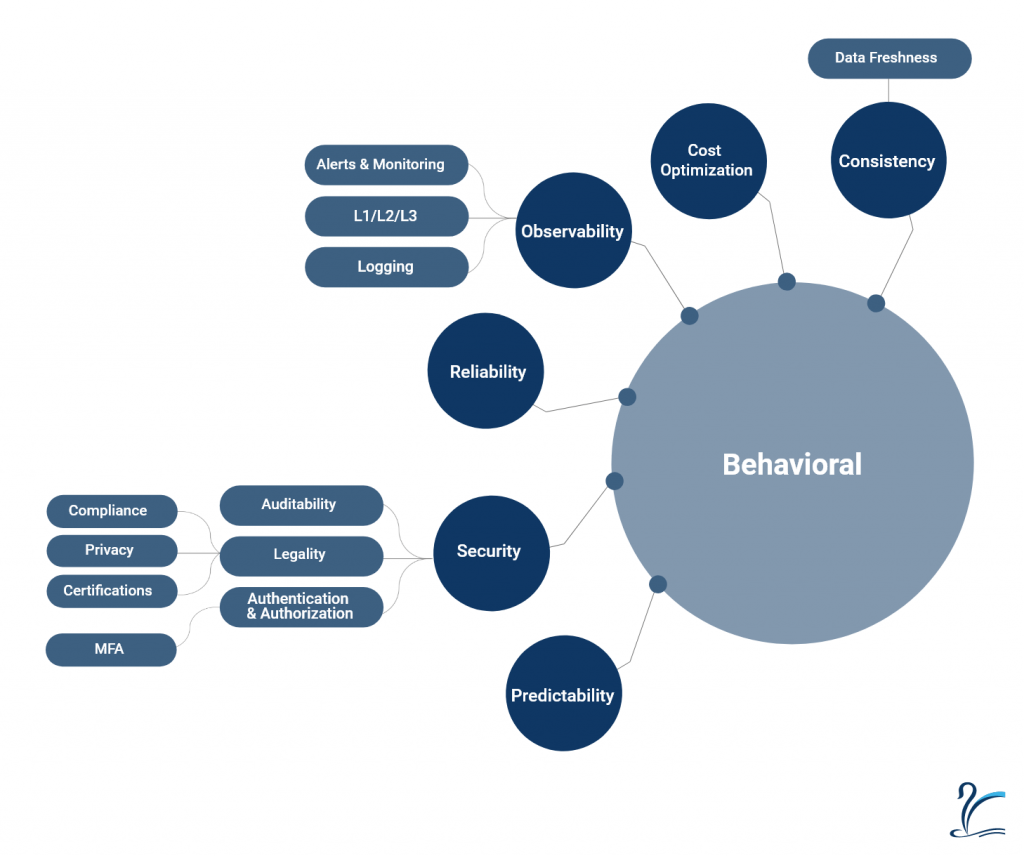
Security
Security is the degree to which the application protects data, information, systems, and assets. This is achieved by:
- Authenticity or employing a robust identity foundation
- Accountability by permitting traceability
- Nonrepudiation by applying security at all layers
- Automating security best practices
- Shielding data in transit and at rest
- Maintaining confidentiality of data
- Maintaining integrity by restricting user access to all data
- Establishing mechanisms to spot security events
- Auditability: The architectural design needs to be auditable so that audit trails can track the system activity and the mechanism and extent of the breach when a security breach occurs. To prevent the intruders from covering their attacks, you should store the audit trails remotely, where they can only be appended.
- Legality: The application architecture should be compliant and adhere to data protection laws like GDPR, SOC2, CCPA, PIPL, or FedRamp. It should also maintain privacy by hiding encrypted company transactions from internal employees (including DBAs and network architects) as well.
- Authentication: It is imperative to ensure users are who they say they are. Based on identity, users are then authorized to access only certain functions within the application (by either use case, business rule, field level, subsystem, etc.) to keep data secure.
Reliability
An architectural design can be considered reliable only if the internal structure is accessible only to legitimate users. Also, authenticated and authorized users should not be able to misuse the data or parts made accessible to them. Thus, apart from ensuring that a disaster cannot make the application unavailable, reliability should ensure that the architecture design can avert large volumes of effort from being wasted.
Consistency
The application architecture should ensure consistency in data across all nodes after the execution of every operation. This allows all clients to see the same data simultaneously without being affected by the node they connect to. Thus, consistency improves the freshness of data.
Observability
The application should be able to collect program execution data, internal states of modules, and interactions between components. The architectural design should include various logging and tracing techniques and tools that enhance observability.
Logging: The logging tools included in the application architecture record different types of logs generated within each request, such as event logs, transaction logs, message logs, and server logs.
Alerts & Monitoring: The architecture needs monitoring dashboards, service level indicators (SLI), and critical alerts setup.
L1 / L2 / L3: An eminent architecture clearly defines the roles at different levels and sets up an on-call support process for L1 / L2. At L1, the assistance includes interaction with customers, while at L2, support helps troubleshoot and manage the tickets routed to them by L1. At L3, i.e., the last line of support comprising a development team addresses the technical issues.
Cost Optimization
The architecture of an application cannot overlook the cost aspect involved in the design and implementation. It demands the right type and quantity of resources that can be scaled to meet business requirements without overspending. You must understand spending overtime and control fund allocation to avoid unnecessary costs.
Predictability
After planning, you can draw the architectural design on paper, but its actual execution involves multiple processes ranging from development to verification, repair, upgrade, and maintenance. You also need to validate the capacity of your technological choices and human resources. Even after all this, a perfectly working system experiences wear and tear over time. Therefore, it is crucial for it to maintain the continuity of processes even while undergoing maintenance. To achieve this, it should be able to forecast its health’s downfall and raise alerts to prevent a potential failure instead of merely reacting after the failure occurs. The architecture should also offer meaningful insights for future capacity planning. This can be accomplished through automated deployment, testing, builds, etc.

Conclusion
Application/software architecture is not just about simply drawing arrows and other shapes to portray key components, complex use cases, and their respective interactions. An outstanding and innovative architectural design goes beyond – diving into depths and seeking the right context and characteristics.
A thorough knowledge of these characteristics in context to your application/software can help you choose the right fit for your project needs and adopt them within your project. You can also identify the bottlenecks or less-performing areas in your current application and consider them as a starting point to improve the overall reliability and performance of the system.
Our team of seasoned experts at Cygnet can help you dive into the depths of these architectural design principles and assist in creating architectures using the best technology stack. Learn more about our architectural excellence offerings and partner with us to achieve your goals.
Author


Abhijit Sen
VP & Head of Architecture and Innovation
Abhijit Sen is a business and technology architect with a proven ability to develop and implement Information Technology strategies to drive business operations. 14 years of experience in Fintech across technology and strategic change management with significant analysis, design, and architecture contributions to the delivery of regulatory, control, and large-scale changes.