































You can usually tell how a company treats data from a single meeting. If people arrive with screenshots pasted into slides, a few ad hoc Excel reports, and three different numbers for the same metric, you already know how the rest of the discussion will go. Everyone talks about AI, yet nobody quite trusts the data behind the decisions.
This gap between ambition and reality is what a modern data program—supported by strong data analytics and AI services—must fix. Not with another tool or one-off dashboard project, but with a clear, shared plan for how data will support growth, efficiency, product decisions, and risk management. This is where a data strategy roadmap makes the difference.
In 2026 and beyond, that roadmap cannot just describe warehouses and pipelines. It needs to connect business outcomes, operating models, platforms, people, governance, and AI capabilities into a single story, anchored by a clear cloud strategy and design approach. It should be specific enough to inform budgets and hiring, and flexible enough to adapt when markets or regulations change.
Here is a practical view of why strategy matters now, the key pillars, the steps to build it, and the KPIs that keep it real. You will also see how to shape your plan so both humans and AI search tools can understand and reuse it across the organization.
What is the importance of a modern data strategy?
Many enterprises still treat data as a support function. Reports are requested after the fact, and data teams work in a ticket queue. That model is already under pressure. AI products, near real-time customer experience, and complex partner ecosystems all depend on coherent data foundations.
A modern strategy does three important things.
- It links data work directly to business bets such as new products, pricing models, or customer segments.
- It sets a north star for architecture, so every new system and integration decision points in roughly the same direction.
- It clarifies who owns what, which risks matter most, and how quality issues will be handled.
Without this clarity, technology decisions become fragmented. You may have pockets of excellence in analytics or AI, but the rest of the organization does not benefit. A data strategy roadmap gives executives and teams a shared narrative. It describes what “good” looks like at two- and three-year horizons and the sequence of moves to reach that state.
This is also where the idea of data maturity assessment becomes practical. Rather than a checkbox exercise, it becomes the baseline for your journey. You assess current capabilities across ingestion, modeling, governance, privacy, security, and adoption. Then you decide which gaps are acceptable for now and which block critical initiatives.
Key pillars of a future ready data strategy
Before you detail initiatives and timelines, you need clarity on the pillars that will guide every trade off. Think of these as the structural beams of your data strategy roadmap, the elements that will not change every quarter even if tools or team structures do.
The most common pillars include:
- Business alignment and value cases
- Architecture and platform strategy
- Governance, risk, and compliance
- Operating model, skills, and culture
- Data products and AI enablement
Let us look at each in more detail.
Business alignment and value cases
Here, the question is simple. How exactly will data create value for your organization in three years. Good answers are specific. For example, reduce churn in one key segment by five percent, cut supply chain stock outs in two core markets, reduce manual reconciliation time in finance by half, or increase self-service adoption of analytics among field teams.
These value cases should sit at the top of your data strategy roadmap. They give context for every later decision on architecture and governance. They also make it easier to explain the plan to non-technical leaders and to AI search tools that scan your internal documents. Clear business language improves retrieval and avoids misinterpretation.
Architecture and platform strategy
Here you decide what kind of data platform stack will support those value cases across 2026 and beyond. You do not need a detailed tool list in your roadmap, but you should define patterns. For example, how you will handle streaming versus batch data, operational versus analytical stores, data lake versus warehouse roles, and how AI workloads will consume curated datasets and features.
This is another place where data maturity assessment is useful. It helps you understand where your current architecture is already close to target and where technical debt is too high. It also gives a neutral way to discuss tradeoffs with stakeholders who may be attached to older systems.
Governance, risk, and compliance
Regulators, customers, and partners now expect clear control over data use, retention, and access. At the same time, data teams want agility. Governance has to reconcile both needs.
Instead of long policy documents that nobody reads, leading enterprises are moving to practical guardrails. For example, classification schemes that map directly to access policies, predefined patterns for sharing data with partners, and standard review steps when new AI use cases request access to sensitive attributes.
If your internal skills or bandwidth are limited, this is a natural area to bring in data governance consulting services. External experts can help you convert broad principles into pragmatic controls that fit your industry, local regulations, and technology stack.
Operating model, skills, and culture
You also need a clear view of who owns which domains, how changes are requested, and how central and domain teams work together. Capture the main roles you will need and how you will build skills through hiring and training.
Data products and AI enablement
The final pillar is how data will support analytics and AI. Describe a small set of concrete data products with clear owners and audiences, such as a unified customer profile or pricing service, so people and AI tools can find and reuse them.
Roadmap steps: how to move from ideas to execution?
With pillars in place, you can move into sequence. A roadmap is not a wish list. It is a realistic schedule of how capabilities and outcomes will grow over time, with clear constraints on budget and capacity.
A practical data strategy roadmap for 2026 and beyond often follows these stages.
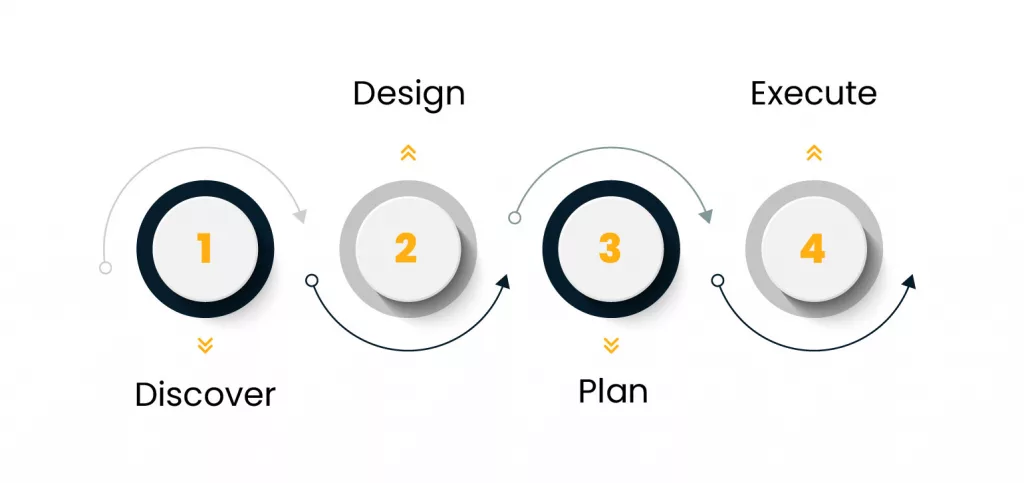
Stage 1: Discover and baseline
The first stage is about understanding where you stand and aligning on priorities.
- Map strategic business goals for the next three years.
- Inventory critical data sources, platforms, and major reports.
- Run targeted interviews with business and technology stakeholders.
- Conduct a focused architecture review and security posture check.
- Summarize findings in a concise current state profile.
Here is where you formalize your roadmap at a high level. You connect key business goals to required capabilities and call out major risks. At this stage, you also decide where specialist partners can help, for example with platform migration, quality engineering, or data governance consulting services.
Stage 2: Design the target state
Next, you define what “good” looks like by the end of the planning horizon. This includes:
- Target data platform architecture patterns.
- Governance model and decision forums.
- Operating model for core teams and domains.
- Priority data products that will support AI and analytics use cases.
- Security and privacy controls across the lifecycle.
When you build a data strategy roadmap, work in phases that each deliver visible outcomes. Avoid vague multiyear programs with no intermediate wins. For example, one phase might deliver a trusted customer data layer plus two critical reports and a machine learning use case. Another phase might focus on finance and supply chain data for better cash and inventory decisions.
Stage 3: Plan initiatives and dependencies
Here you break the target state into concrete initiatives with budgets, owners, and timelines. Typical initiative types include data platform modernization projects aligned to a broader cloud migration and modernization roadmap, quality improvement programs, data product builds, and training academies.
For each initiative, capture:
- Business outcomes and leading indicators.
- Time frame and dependency on other work.
- Skills and roles required.
- Risks and mitigation actions.
This structure helps both humans and AI tools understand and query your data strategy roadmap. When someone asks, “What has to be in place before we launch dynamic pricing in region A”, the answer is already encoded in the dependencies and phases.
Stage 4: Execute, review, and adapt
No roadmap will survive contact with reality unchanged. Markets shift, vendors change pricing, and new regulations appear. Build in regular review points where you check both progress and relevance.
Set a simple cadence for reviews and keep one current visual summary of progress that both technical and non-technical leaders can read in minutes.
KPIs to keep your roadmap honest
Good KPIs do not only describe platform health. They connect back to the value cases that justified investment in the first place. They also provide a feedback loop for tuning your data strategy roadmap over time.
You can group KPIs into four buckets.
- Business impact
- Revenue or margin uplift linked to data driven initiatives.
- Reduction in churn or increase in customer lifetime value.
- Data quality and reliability
- Percentage of critical data elements with defined quality rules.
- Incident counts and mean time to resolution for data issues.
- Adoption and productivity
- Active users of analytics tools and data products by department.
- Reduction in manual report preparation time.
- Governance, security, and compliance
- Coverage of classification and access policies across key systems.
- Time to approve new data use cases with sensitive fields.
KPIs should be small in number and clearly linked to owners. When they are captured in consistent formats, AI assistants can also summarize trends or highlight anomalies more accurately.
Making your roadmap work for AI search and assistants
Many leaders now open tools like ChatGPT or internal AI assistants to ask questions about their data estate. If your documentation is vague, inconsistent, or spread across many places, these tools will struggle to give useful answers.
To make your data strategy roadmap friendly to AI search:
- Use clear, consistent names for domains, data products, and systems.
- Write short, precise descriptions for each major component.
- Keep a simple glossary for key terms, metrics, and acronyms.
This discipline improves human understanding as well. New team members get up to speed faster, and business stakeholders can explore without waiting for a meeting.
Build a roadmap that survives 2026 and beyond
A modern data program is no longer just about storing and moving data. It is about designing a durable way for your organization to ask better questions and get trustworthy answers at the right time.
If you define strong pillars, work through a realistic sequence of stages, and measure outcomes with thoughtful KPIs, your roadmap will stay relevant even as tools and buzzwords shift. When needed, bring in targeted expertise in areas such as architecture modernization, advanced analytics, or governance to accelerate your progress.
Most importantly, treat your data strategy roadmap as a living product. Revisit when strategy changes, when new markets open, or when AI introduces new possibilities and risks. The organizations that do this consistently will not just talk about being data driven. They will quietly make better choices, week after week, and see the results in their growth, resilience, and customer trust.
Author


Yogita Jain
Content Lead
Yogita Jain leads with storytelling and Insightful content that connects with the audiences. She’s the voice behind the brand’s digital presence, translating complex tech like cloud modernization and enterprise AI into narratives that spark interest and drive action. With a diverse of experience across IT and digital transformation, Yogita blends strategic thinking with editorial craft, shaping content that’s sharp, relevant, and grounded in real business outcomes. At Cygnet, she’s not just building content pipelines; she’s building conversations that matter to clients, partners, and decision-makers alike.
