



















The first time a developer says, “We’ll just do it in another account,” you know governance has failed.
Not because the rules were weak.
Because they were heavy.
That tension between speed and control is at the center of every cloud conversation in 2026. Enterprises want innovation. They want GenAI pilots, new data products, and faster releases — often supported by structured Amazon Web Services consulting services that align experimentation with governance. At the same time, boards are asking sharper questions about risk, compliance, and cloud spend.
This is where AWS governance either becomes a competitive advantage or a silent blocker — especially when supported by a well-defined cloud strategy and design framework that aligns security with speed.
The truth is simple. If your AWS guardrails slow teams down, they will work around them. If they are designed well, teams will barely notice them. And that difference decides whether cloud becomes a growth engine or a governance headache.
Let’s break this down in a practical way.
The Real Challenge: Governance vs Agility
Most organizations frame it incorrectly.
They treat governance and agility as opposites. Security wants control. Engineering wants speed. Leadership wants both.
The real question is not “control or speed?”
It is “How do we design boundaries that protect the business without interfering with delivery?”
This is the heart of balancing governance and agility AWS environments demand today.
In early cloud adoption phases, governance often looks like this:
- Central team approves every new AWS service
- Long exception workflows
- SCPs that deny broad categories of actions
- Security reviews before each production release
That works when you have ten workloads. It collapses when you have two hundred.
Modern enterprise cloud governance models treat guardrails as architecture, not paperwork — a principle central to strong cloud engineering services. They assume teams will move fast. The goal is to make the safe path the easiest path.
Understanding AWS Guardrails: What They Really Are
When people hear “guardrails,” they often think of restriction. In practice, AWS guardrails are simply pre-defined boundaries inside which teams can operate freely.
Think of it like a highway.
The lanes do not slow you down.
They prevent chaos.
In AWS, guardrails typically fall into three categories:
1. Identity Guardrails
Who can do what, and under which conditions.
- IAM permission boundaries
- IAM Identity Center policies
- Restrictions on root usage
- MFA enforcement
2. Network and Data Guardrails
Where data can live and how it is accessed.
- Region restrictions
- Encryption requirements
- S3 public access blocks
- VPC design standards
3. Financial and Operational Guardrails
How cost and operational risk are contained.
- Budget alerts
- Mandatory tagging
- Logging requirements
- Backup policies
The mistake is designing these controls in isolation. Strong AWS governance connects them into a coherent model tied to business risk.
Preventive vs Detective Controls: Choosing the Right Tool
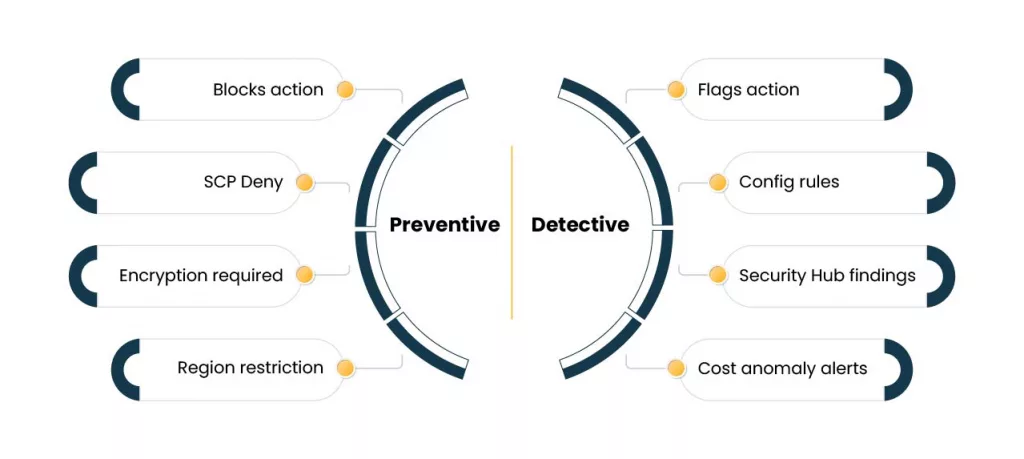
One of the most misunderstood parts of governance design is deciding what to block and what to monitor.
Not everything needs to be prevented.
There are two primary control types:
Preventive Controls
They stop an action before it happens.
Examples:
- SCPs that deny use of non-approved regions
- Blocking public S3 buckets
- Denying disabling CloudTrail
- Restricting creation of unmanaged admin roles
Preventive controls are powerful, but they must be used carefully and aligned with proven securing cloud infrastructure best practices to avoid unnecessary delivery friction. Overuse leads to friction.
Detective Controls
They allow action but flag issues after the fact.
Examples:
- AWS Config rule violations
- Security Hub findings
- IAM Access Analyzer alerts
- Cost anomaly detection
Detective controls assume teams are capable of fixing issues quickly. They support agility because they do not block experimentation.
Strong AWS governance uses preventive controls for irreversible or high-impact risks. Everything else is better handled through detection and remediation.
That is a practical approach to balancing governance and agility AWS environments need.
Designing SCPs Without Breaking Innovation
Service Control Policies are often the sharpest tool in the box. Used correctly, they are precise. Used poorly, they suffocate teams.
Following solid AWS SCP best practices is critical.
Instead of writing SCPs that say:
- “Only these 15 services are allowed”
- “Everything is denied unless approved”
Focus on denying clearly defined high-risk actions.
For example:
- Deny disabling organization-level CloudTrail
- Deny deleting Config recorders
- Deny creating public AMIs
- Deny turning off encryption where supported
- Deny changes to shared networking in core accounts
- Deny actions outside approved regions
Notice what is not denied.
You are not blocking entire services. You are blocking unsafe configurations.
This approach aligns with scalable AWS governance. As AWS releases new services, teams can test them in approved zones without waiting for a governance committee to update a master allowlist.
SCP design should follow three principles:
- Deny irreversible damage.
- Protect shared infrastructure.
- Keep policies readable and OU-specific.
Anything else likely belongs in detective controls.
Organizational Structure: Governance by Design
Guardrails work best when the account structure supports them.
An effective pattern used in mature enterprise cloud governance models is a multi-OU design:
Core / Shared Services OU
Strict controls.
Only the platform team deploys here.
Identity, logging, networking live in this zone.
Production OU
Strong preventive controls.
Approved regions only.
Mandatory encryption and logging.
Non-Production OU
More flexible.
Teams can experiment with services within budget and identity constraints.
Sandbox OU
Time-bound experimentation.
Low budgets.
Aggressive monitoring.
This structure supports scalable AWS governance without creating approval bottlenecks. Teams know where experimentation is safe and where controls are tighter.
Structure reduces the need for constant exception requests.
Delegated Ownership: The Missing Piece
Many governance programs fail not because of technical design, but because of unclear ownership.
If security approves every change, speed drops.
If no one owns compliance, risk rises.
Effective AWS governance distributes responsibility:
- Platform team owns baseline guardrails and AWS Organizations.
- Security defines control objectives and monitors risk posture.
- Product teams own workload-level IAM roles, configurations, and remediation.
- FinOps owns tagging standards and cost monitoring.
This model ensures AWS guardrails provide boundaries while teams retain autonomy inside them.
Delegation works when teams can say “yes” within predefined limits. They do not need approval for every deployment. They only need to operate within established boundaries.
That is real balancing governance and agility AWS leadership expects.
Measuring Whether Governance Is Working
If you cannot measure it, you are guessing.
Traditional governance reports focus on activity:
- Number of policies created
- Number of Config rules enabled
- Number of controls passed
Those metrics do not show impact.
Instead, measure outcomes:
1. Guardrail Bypass Rate
How often do teams request exceptions?
A high rate suggests controls are unrealistic.
2. Mean Time to Remediate Findings
How quickly do teams fix security or compliance issues?
Fast remediation indicates healthy detective controls.
3. Deployment Lead Time
Has release velocity dropped after new guardrails?
Good AWS governance should not significantly increase delivery time.
4. Default Compliance Rate
What percentage of new workloads meet compliance requirements without manual intervention?
This is the strongest signal of mature scalable AWS governance.
When compliance becomes the default state, governance is working.
Governance in 2026: Beyond Infrastructure
Today, risk is not limited to open ports or public buckets.
It includes:
- AI workloads using sensitive data
- Untracked third-party integrations
- Data residency violations
- Cloud cost spikes from experimentation
- Services deployed without understanding pricing models
Modern enterprise cloud governance models extend guardrails into these domains.
That means:
- Data classification policies enforced at account level
- Clear rules for AI and model training data
- Budget guardrails for experimental environments
- Vendor integration review processes
These are business-level controls. They protect revenue and reputation, not just infrastructure.
A Practical Governance Blueprint
If you are redesigning your approach this year, keep it simple and practical:
- Use SCPs to deny only high-impact, high-risk actions.
- Keep preventive controls minimal but strong.
- Rely on detective controls for configuration drift and policy violations.
- Separate experimentation from production via OU structure.
- Delegate workload responsibility to product teams.
- Measure outcomes, not policy volume.
Above all, treat governance like a platform product.
A product has users.
Developers are your users.
If your AWS guardrails create daily friction, they are not designed correctly. If teams move quickly and compliance evidence is automatically generated, your AWS governance is doing its job.
Innovation does not slow down when guardrails are well designed. It accelerates because teams trust the boundaries.
And in 2026, that trust is what separates organizations that merely run on AWS from those that build confidently on it.
Author


Yogita Jain
Content Lead
Yogita Jain leads with storytelling and Insightful content that connects with the audiences. She’s the voice behind the brand’s digital presence, translating complex tech like cloud modernization and enterprise AI into narratives that spark interest and drive action. With a diverse of experience across IT and digital transformation, Yogita blends strategic thinking with editorial craft, shaping content that’s sharp, relevant, and grounded in real business outcomes. At Cygnet, she’s not just building content pipelines; she’s building conversations that matter to clients, partners, and decision-makers alike.