






























Oman e-invoicing is moving from policy intent to regulatory reality. Under the Fawtara program led by the Oman Tax Authority (OTA), the country is introducing mandatory structured digital invoicing for all VAT-registered businesses. The objective is clear: improve VAT compliance, reduce fraud, and give the tax authority near real-time visibility into transaction data.
This shift replaces paper and PDF invoices with machine-readable XML/JSON formats, exchanged through a five-corner model using accredited service providers. The OTA has indicated phased implementation beginning as early as August 2026, subject to final regulatory confirmation, giving businesses a narrow window to modernize systems, processes, and controls.
For finance, tax, and IT leaders, Oman e-invoicing is not just another filing requirement it fundamentally changes how invoices are created, validated, transmitted, and stored, making the choice of an Oman E-invoicing solution a core operational decision.
Regulatory Background: How Oman Reached This Point
Oman introduced VAT in 2021 at a standard rate of 5%, supported by Sultani Decree 151/2020 and Decree 121/2020 its Executive Regulations. These rules established baseline invoicing requirements such as:
- Unique invoice numbers
- Supplier and buyer VAT identification numbers (VATINs)
- Invoice dates, taxable values, and VAT amounts
In October 2022, amendments to the Executive Regulations formally recognized electronic tax invoices, setting the legal foundation for full e-invoicing.
Building on this, the OTA partnered with Omantel to develop the Fawtara platform, aligning Oman’s tax digitization with Vision 2040 and wider GCC trends already visible in Saudi Arabia and the UAE. The regulatory direction is consistent across the region: move from post-transaction VAT reporting to transaction-level digital controls.
What changes now is not the obligation to issue invoices, but how invoices are issued and validated—digitally, in a standardized format, and under the oversight of the tax authority.
Expected Oman E-Invoicing Framework
Oman’s e-invoicing framework is designed around a five-corner, Peppol-aligned model, introducing intermediated validation without direct supplier-to-authority submission.
How the five-corner model works
- Supplier generates the invoice in its ERP or billing system
- Invoice is sent to the Supplier’s Accredited Service Provider (ASP)
- The ASP validates structure and schema, then submits data to OTA (Fawtara)
- OTA performs tax checks and approves or rejects the invoice
- Approved invoice flows to the Buyer’s ASP, and then to the Buyer
This model balances regulatory control with enterprise scalability, avoiding a single centralized clearance bottleneck.
Key technical characteristics
- Formats: )Structured XML (with schema defined by OTA) is expected to be the primary format, with API-based data exchange. Final schema details are subject to official technical documentation.
- Data depth: ignificantly expanded mandatory data fields compared to current VAT invoicing requirements
- Invoice types: Standard invoices, simplified invoices (B2C), credit and debit notes
- Controls: Unique identifiers, cryptographic validation, timestamps, and QR codes (particularly for simplified invoices) are expected under the technical controls framework.
- Language: Arabic and English supported
- Archiving: Records must be retained for at least 10 years in accordance with VAT record-keeping rules.
For enterprises, this means invoice data quality and system integration become non-negotiable.
Oman E-Invoicing Timeline & Phases
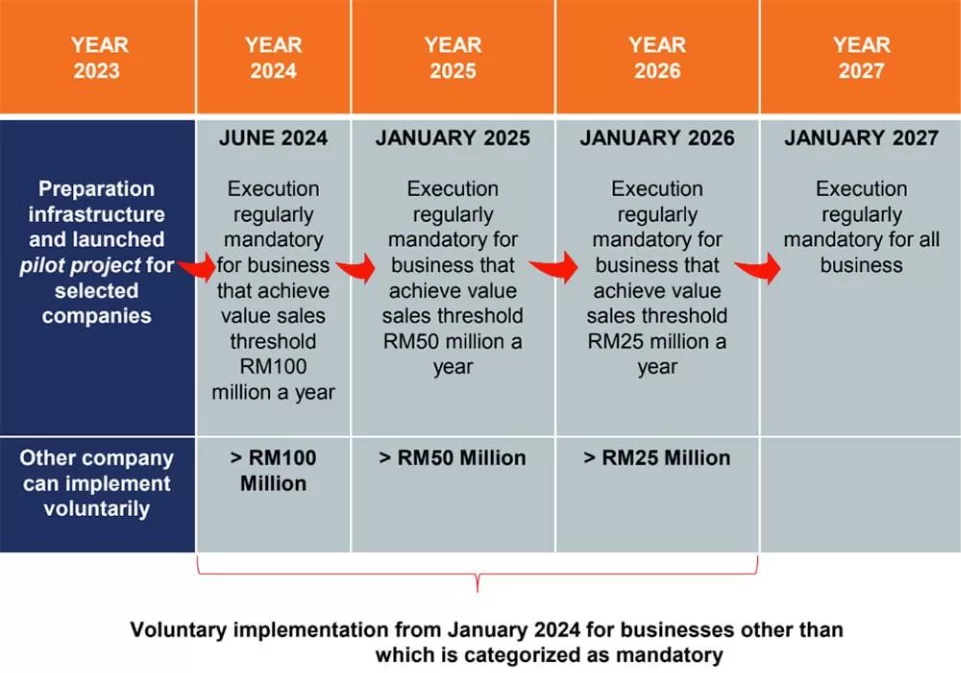
While dates may still be refined, Oman has already signaled a phased rollout approach, consistent with other GCC mandates.
Preparatory phase (2025–mid-2026)
- Regulatory consultations and data dictionary finalization
- Publication of technical specifications and ASP accreditation standards
- Developer sandboxes and pilot testing environments
Mandatory rollout phases
By August 2028, Oman is expected to reach near-universal e-invoicing coverage. Voluntary or early adoption is likely to be encouraged ahead of mandates.
Businesses Impacted by Oman VAT E-Invoicing Requirements
All VAT-registered businesses issuing taxable supplies will eventually fall within scope. Phasing is expected to be driven by turnover, tax contribution, and invoice volumes.
In-scope transactions
- B2B invoices
- B2C simplified invoices (with QR codes)
- Credit and debit notes
- Eventually, B2G transactions
Limited exclusions
- Supplies that are fully VAT-exempt under existing VAT law
- Certain foreign suppliers without a local VAT registration may be deprioritized initially
Operational impact areas
- ERP and billing system upgrades
- Onboarding with an OTA-accredited ASP
- Redesign of invoice approval, issuance, and correction workflows
- Increased scrutiny on VAT master data and transaction accuracy
Broad coverage is expected, with phased onboarding rather than permanent exemptions for most VAT-registered businesses.
How Businesses Should Prepare Now
Waiting for the final notification compresses timelines and increases risk. Practical preparation should start now.
1. Assess your current invoicing landscape
- Which systems generate invoices (ERP, POS, billing tools)?
- Are invoices structured or PDF-only?
- How many invoice types and exceptions exist?
2. Check ERP and integration readiness
- Ability to generate XML/JSON invoices
- Support for UUIDs, digital signatures, QR codes
- API connectivity with external platforms
3. Prepare for expanded data requirements
With 50+ mandatory fields, gaps in:
- VAT classification
- Customer and supplier master data
- Line-level tax logic
will surface immediately under e-invoicing.
4. Plan ASP onboarding and testing
- Track OTA accreditation announcements
- Budget for ASP services, integration, and storage
- Test end-to-end flows in the OTA sandbox well before go-live
5. Train finance and IT teams
E-invoicing blurs traditional ownership lines. Tax, finance, and IT teams must operate with shared accountability.
Conclusion
Oman e-invoicing under the Fawtara program transforms VAT compliance from a periodic reporting exercise into a transaction-level digital control system. For the OTA, this means better compliance and fraud prevention. For businesses, it introduces new obligations—but also an opportunity to modernize invoicing, reduce manual effort, and improve audit readiness.
With mandatory phases starting August 2026, the real risk is not regulation—it is late preparation. Enterprises that start aligning systems, data, and partners now will navigate Oman e-invoicing with confidence, while others may face invoice rejections, penalties, and operational disruption.
Author


Mauli Shah
Ast. Marketing Manager
Mauli Shah brings a dynamic background in sales and marketing, with a sharp eye for client-centric communication and a passion for storytelling. With a strong foundation in understanding client perspectives, Mauli seamlessly bridges strategy with creativity in her writing. She specializes in content creation that not only informs but engages, offering readers insights grounded in real-world business acumen.
At Cygnet Tax, Mauli contributes to thought leadership through insightful blogs that bridge innovation, business impact, and customer experience.
Mauli is passionate about crafting content that informs, inspires, and adds value—whether through strategic messaging or engaging storytelling. She believes in the power of words to connect ideas, influence decisions, and drive change.
