







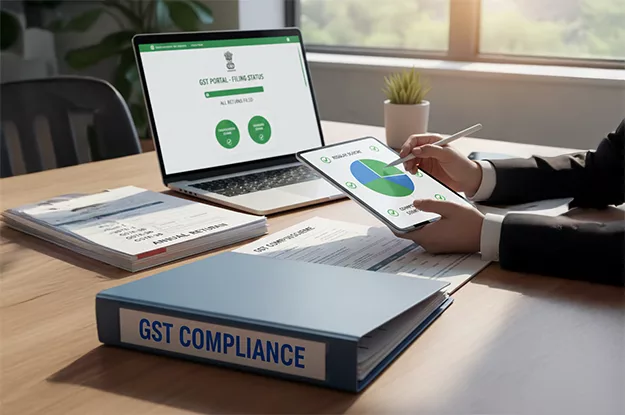























If you’ve been in Indian finance or tax for the last eight years, you’ve lived through it: the 14th of the month arrives, GSTR-2B drops on the portal, and suddenly the entire tax team is glued to laptops, downloading JSON files, opening countless Excel sheets, and praying that this month the mismatches are “manageable.”
Despite GST being eight years old, organisations still struggle with managing invoice-level data at scale. The data explosion is real: multiple GSTINs, multiple ERPs, thousands of invoices from vendors in varying formats, and the complexity of vendor compliance behaviour.
This is precisely where organisations begin to mature from “manual GST filing” to adopting structured Invoice Management Systems platforms that don’t just reconcile data but fix the problem at the source.
Before we get into how technology simplifies all of this, let’s quickly align on the two most crucial forms in the monthly GST cycle – GSTR-2B and GSTR-3B.
Understanding GSTR-2B and GSTR-3B: Why These Two Forms Drive All GST Conversations
Even seasoned professionals joke about the push-and-pull relationship between these two returns. If GSTR-2B is the monthly Bible for Input Tax Credit (ITC), GSTR-3B is the monthly confession.
GSTR-2B: The ITC Source of Truth
GSTR-2B is a static statement generated by the GST portal. It tells you exactly how much ITC you are eligible to claim for a specific tax period.
But here’s the catch, the accuracy of GSTR-2B depends entirely on how compliant your vendors are. If they don’t upload invoices or file their GSTR-1 on time, your 2B is incomplete, no matter how legitimate your purchases are.
That’s why GSTR-2B reconciliation is a non-negotiable process. You can’t simply accept 2B as-is; you must verify, validate, and match it with your purchase register or GRN data.
GSTR-3B: The Return Where Everything Gets Finalised
GSTR-3B is where ITC gets claimed. For CFOs, this form directly impacts monthly cashflows.
If ITC is under-claimed due to poor reconciliation, you pay extra tax in cash. If you over-claim, you invite scrutiny, notices, penalties, and interest. That’s why a precise comparison of 2B and purchase data is vital before filing 3B.
Together, these two forms decide:
- how much tax you pay,
- how much credit you claim, and
- how compliant your vendor ecosystem is.
And this is where organisations either excel… or begin to feel the monthly stress spiral.
How Reconciliation Happens: The Process Nobody Enjoys but Everyone Must Master
Speak to any IT or ERP Head, and they’ll tell you the same thing, GSTR-2B reconciliation is not difficult because of the GST rules; it’s difficult because of data misalignment.
Let’s walk through what really happens behind the scenes.
Step 1: On the 14th–15th, the tax team pulls data from GSTR-2B from the portal, Purchase register or GRN data from ERP, Vendor communication updates (like emails, WhatsApp confirmations, or call logs). This sounds simple, but in reality, purchase data alone can sit across SAP, Oracle, Tally, custom ERPs, or even spreadsheets.
Step 2: Someone opens both files side-by-side and starts the painful ritual of matching invoice number, date, GSTIN, taxable value, and tax amount line by line. Even if you call it “invoice number,” your vendor might call it: Bill No., Document No., Tax Invoice, INV2024-15, or worse upload with extra characters, spaces, or typos. GSTN’s system is strict; your ERP is flexible. That mismatch keeps growing.
Step 3: Hundreds (or thousands) of mismatches are dumped into a “reconciliation sheet” with colourful tags – Missing in 2B, Missing in Books, Amount Mismatch, Tax Rate Mismatch, Duplicate, etc.
Step 4: The team spends the next 10–15 days chasing suppliers for amendments, reversing excess ITC, and documenting everything for audit defence.
Step 5: The adjustments before GSTR-3B Filing where Tax Heads and CFOs sit together to make decisions: Should ITC be claimed fully? Should partial ITC be claimed? Should it be deferred? Should it be reversed? Should payment blocks be applied for non-compliant vendors?
Step 6: Once the reconciliation is finalised, the output gets structured so it can directly feed into: ERP systems, GSTR-3B filing teams, Internal MIS and compliance reports
The Real Benefits: Why Enterprises Are Moving to Invoice Management Systems
When GST was introduced, many organisations thought reconciliation was a one-time exercise. But today, it’s one of the most repetitive and labour-intensive processes.
That’s why automation through an Invoice Management System is no longer a “good-to-have” it’s a compliance survival strategy.
If your team is still asking what is invoice management system, it’s essentially a platform that captures, standardises, validates, and reconciles invoice data so GST compliance doesn’t rely on manual spreadsheets and last-minute firefighting.
Here’s how IMS works behind the scenes and why teams rely on it.
1. Centralised, Clean Data Without the Manual Effort
An IMS automatically pulls data from ERPs like SAP and Oracle, GSTN (GSTR-2B, 2A, GSTR-1), and even vendor uploads. Instead of scattered spreadsheets, everything sits in one place. The system also standardises invoice numbers, formats, and vendor variations so that reconciliation starts with clean, trustworthy data.
2. Zero Last-Minute Scramble
Instead of waiting for the 2B to release and rushing into reconciliation, systems run validations throughout the month. Teams can track vendor compliance behaviour long before filing deadlines.
3. Increased ITC Accuracy and Savings
Instead of waiting until month-end, tax teams get a live view of:
- Eligible ITC
- Deferred ITC
- At-risk ITC
- Vendor-wise ITC loss
This allows CFOs to forecast working capital and manage cashflows with far more confidence.
4. Automated Vendor Compliance and Follow-Ups
A large portion of reconciliation delays come from vendors not filing accurately or on time. IMS handles this through automated nudges—alerts for missing invoices, reminders to file GSTR-1, and notifications about mismatches. Vendor compliance improves quickly, which directly improves monthly ITC accuracy.
5. Smoother, Faster GSTR-3B Filing
By the time filing day arrives, the IMS has already completed the heavy lifting—data cleansing, 2B comparison, exception handling, and ITC classification. Tax teams simply review the final numbers and upload for filing. No last-minute scramble, no surprises.
6. Audit-Ready Trails and Governance
Every action – matching, reviewing, editing, deferring is logged.
This creates a strong audit posture and significantly reduces the risk of disputes during departmental reviews.
Where Cygnet One’s Invoice Management System Stands Out
While multiple tools claim to automate reconciliation, very few handle compliance at enterprise scale. Cygnet’s IMS brings together automation, intelligence, and compliance depth in one unified platform.
What Makes Cygnet IMS Different?
If you’re evaluating tools, these are the Features of Invoice management system that matter most for enterprise-grade GST reconciliation and filing.
1. Multi-Level Reconciliation Engine
Cygnet handles 200+ business and GSTN validation checks, ensuring every invoice is evaluated with precision.
2. Smart Vendor Compliance Profiling
The system tracks vendor filing behaviour, GSTR-1 status, consistency, and historical accuracy to help companies decide payment priorities and ITC eligibility.
3. Seamless ERP Integration
Whether it’s SAP S/4HANA, Oracle, Tally, or home-grown ERPs, Cygnet offers secure, scalable, and configurable connectivity.
4. AI-Assisted Exception Handling
Instead of dumping mismatches into spreadsheets, the system provides clear root-cause explanations, next steps, and probable vendor actions needed.
5. Ready for GSTR-2B Reconciliation at Scale
Enterprises processing 100,000+ invoices across GSTINs use Cygnet IMS without performance challenges.
6. End-to-End Invoice Lifecycle Automation
From ingestion to validation to reconciliation to 3B readiness, the platform covers the entire chain.
Conclusion: GSTR-2B to GSTR-3B Doesn’t Have to Be Complicated
GSTR-2B reconciliation will always be the backbone of GST compliance. But it doesn’t have to be a manual, time-consuming burden.
When organisations adopt a robust, scalable Invoice Management System, reconciliation becomes predictable, compliance becomes proactive, and GSTR-3B filing becomes smooth and stress-free.
The journey from 2B to 3B is only difficult when the data is messy.
Clean the data, automate the checks, and let the system do the heavy lifting.
If you’re ready to move from Excel chaos to automated heaven, explore how a new-generation IMS can transform your GST compliance. Many of India’s leading enterprises already have and they’re not going back.
