































Cloud data migration rarely fails because of the cloud. It fails because data is messy, interdependent, and deeply tied to how the business actually runs.
Enterprises today are sitting on years of fragmented datasets spread across legacy systems, on-prem databases, and siloed applications. Moving this data to the cloud is not just a technical shift; it is a complete strategy that includes structured cloud migration planning, security, and execution discipline.
One missed dependency, one unvalidated dataset, or one poorly timed cutover can lead to reporting errors, compliance risks, and lost business trust.
That is why cloud data migration is not all about moving data with speed, it is more about understanding,
- Migration complexity
- Disciplined readiness checks
- Execution of best practices that prioritize cloud migration security
- Rigorous testing before business users ever touch the data
And once the migration is complete, optimization becomes the real differentiator between a successful migration and an expensive data relocation.
In this guide, we break down cloud data migration best practices in detail, explaining readiness checks, testing validation along with post-migration optimization. This blog will help decision-makers move data to the cloud without disrupting the business.
Cloud Migration Readiness Checks: What Should You Assess Before Migrating Data?
Most cloud data migration failures are not caused during execution but due to gaps identified too late in cloud readiness and assessment phases. They happen much earlier during assumptions made in the absence of a structured readiness check. Below are the critical readiness checks enterprises should complete before migrating data.
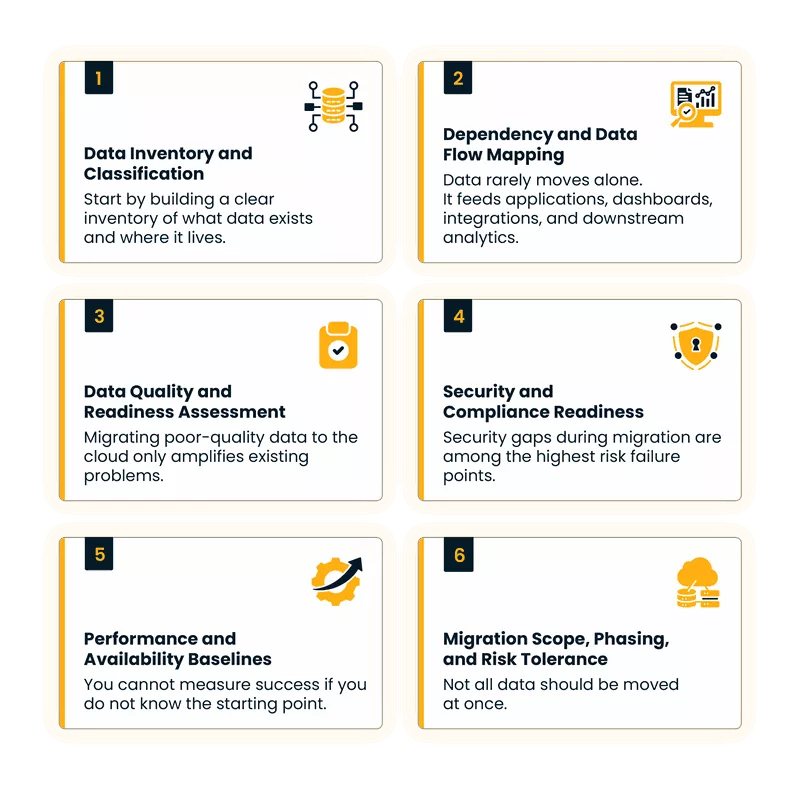
1. Data Inventory and Classification
Start by building a clear inventory of what data exists and where it lives.
- Identify structured, semi-structured, and unstructured datasets
- Classify data based on sensitivity, regulatory impact, and business criticality
- Map data owners and consumers across teams
This step ensures that high-risk or mission-critical data is not treated the same as low-impact archival data during migration.
2. Dependency and Data Flow Mapping
Data rarely moves alone. It feeds applications, dashboards, integrations, and downstream analytics.
- Map upstream and downstream dependencies
- Identify batch jobs, ETL pipelines, APIs, and reporting layers consuming the data
- Flag tightly coupled workloads that may require phased or parallel migration
This prevents broken reports and silent data failures after the cutover.
3. Data Quality and Readiness Assessment
Migrating poor-quality data to the cloud only amplifies existing problems.
- Identify duplicates, null values, schema inconsistencies, and outdated records
- Decide what needs cleansing, archiving, or restructuring before migration
- Align on data validation rules with business stakeholders
This is a foundational input into cloud migration planning and removes your future hurdles.
4. Security and Compliance Readiness
Security gaps during migration are among the highest risk failure points.
- Validate encryption requirements for data at rest and in transit
- Review identity, access, and role-based permissions
- Assess regulatory constraints such as data residency, retention, and auditability
Strong cloud migration security controls must be designed into the migration process, not added later.
5. Performance and Availability Baselines
You cannot measure success if you do not know the starting point.
- Capture current data access latency and throughput
- Identify peak usage periods and business-critical reporting windows
- Define acceptable downtime and performance thresholds
These baselines guide execution strategies and testing expectations.
6. Migration Scope, Phasing, and Risk Tolerance
Not all data should be moved at once.
- Decide what migrates first and what can wait
- Define rollback criteria and success metrics
- Align risk tolerance across IT, security, and business teams
This step converts readiness insights into an actionable cloud migration roadmap aligned with modernization priorities.
Cloud Data Migration Best Practices for Secure and Smooth Execution
Once readiness checks are complete, execution becomes a test of discipline. This is where planning decisions are either validated or exposed. Successful cloud data migration execution is not about moving data fast. It is about moving it in a way that preserves security, accuracy, and business continuity.
The following best practices help enterprises execute cloud data migration with control and predictability.
1. Choosing the Right Migration Approach for Your Data
There is no universal migration method. The approach should be driven by data criticality, dependency depth, and risk tolerance.
- Use phased migration for core business datasets with multiple consumers
- Apply parallel runs for reporting and analytics workloads that require validation
- Leverage hybrid patterns when on-prem and cloud data must coexist temporarily
The wrong approach increases downtime and rework, even if tools are technically sound.
2. Prioritize and Sequence Data Intelligently
Not all data deserves equal urgency.
- Migrate high-value, frequently accessed data first
- Defer archival or low-usage datasets to later phases
- Group datasets based on shared dependencies and usage patterns
This sequencing reduces blast radius and simplifies issue isolation during execution.
3. Secure Data Throughout the Migration Lifecycle
Security controls must remain consistent from source to target.
- Enforce encryption for data in transit and at rest
- Apply least-privilege access to migration pipelines and staging environments
- Maintain audit logs for all data movement activities
Robust cloud migration security during execution prevents temporary exposure risks that are often overlooked.
4. Automate Migration Pipelines Wherever Possible
Manual data movement does not scale at enterprise volumes.
- Use automated ingestion and replication pipelines
- Standardize error handling, retries, and rollback logic
- Monitor pipeline health in real time
Automation improves repeatability and significantly reduces human error during cloud data migration.
5. Maintain Data Integrity and Consistency
Data accuracy is not negotiable in the data migration process. Here are some points to keep in mind while preserving data integrity and consistency.
- Implement checksums, row counts, and schema validation
- Control versioning to avoid overwriting active datasets
- Ensure transactional consistency for operational data
These controls protect downstream systems from subtle data corruption that may not surface immediately.
6. Plan for Rollback and Failure Scenarios
You are moving the complete data of your organization to the cloud, which includes complex systems, infrastructure, and legacy systems, so failures should be expected. Ensure that you are prepared for these failures in advance.
- Define clear rollback criteria before execution begins
- Retain source data until post-migration validation is complete
- Document recovery procedures and decision owners
Rollback planning is a critical part of responsible cloud migration strategy that keeps the organization safe during failure and helps in achieving successful migration.
How to Test and Validate Data After Cloud Migration?
You have migrated all the data, but still validation is pending which might rise as a risk for the organization. Testing is the process that validates this and exposes if there are any gaps in the migration process. This will help organizations in migrating data, which is accurate, secure, and becomes the foundation for operations, analytics, or decision-making.
1. Data Accuracy and Reconciliation Testing
Start by confirming that what moved is exactly what was intended to move.
- Compare row counts, file sizes, and record totals between source and target
- Validate schema consistency and data types
- Use checksums or hash comparisons for large or sensitive datasets
This establishes baseline trust in the migrated data.
2. Data Completeness and Consistency Checks
Partial migrations create silent failures that surface later.
- Ensure all dependent datasets have been migrated together
- Validate referential integrity across related tables
- Confirm that historical and incremental data are both present
Completeness testing prevented reporting mismatches and broken downstream workflows.
3. Performance Testing for Data Workloads
Data may be accurate but still unusable if performance degrades.
- Test query response times and data retrieval latency
- Validate throughput for batch and near-real-time pipelines
- Assess performance during peak usage periods
This confirms that the cloud environment can meet or exceed on-prem performance baselines.
4. Security and Access Validation
Security must be verified again in the testing stage to ensure that it will not impact later on.
- Test role-based access controls and permission boundaries
- Validate encryption settings and key management
- Confirm audit logs and monitoring are active
These checks close the loop on cloud migration security after execution.
5. Business and User Acceptance Testing
Technical validation alone is insufficient. As an enterprise, you should,
- Validate reports, dashboards, and analytics outputs with business users
- Confirm data definitions and metrics match expectations
- Capture feedback before decommissioning legacy environments
User acceptance testing ensures that the migrated data supports real business decisions.
Testing is the final gate before optimization begins. Ignoring this step often results in post-migration hurdles that impact organizational trust and delays value realization.
Post-Migration Optimization: Improving Performance, Cost, and Security
Without optimization, enterprises often carry forward legacy inefficiencies into a more expensive environment. This phase is where migration shifts from a technical milestone to a business enabler.
Post-migration optimization focuses on making data faster to access, cheaper to operate, and safer to govern.
1. Optimize Data Storage and Architecture
Cloud platforms reward intentional design.
- Reorganize data into cloud-native storage formats
- Separate hot, warm, and cold data based on access frequency
- Eliminate redundant datasets created during migration
These steps improve performance while reducing ongoing storage costs.
2. Improve Data Access and Query Performance
Performance tuning should follow real usage patterns.
- Analyze query behavior and access paths
- Introduce indexing, partitioning, and caching where appropriate
- Optimize data layouts for analytics and reporting workloads
Well-optimized data enables faster insights and better user adoption.
3. Control and Optimize Cloud Costs
Migration often increases visibility into inefficient data usage.
- Apply lifecycle policies to move infrequently accessed data to lower-cost tiers
- Monitor storage growth and access patterns continuously
- Align cost ownership with business teams
Cost optimization turns cloud data migration from an expense into a controlled investment.
4. Strengthen Security and Governance Posture
Security is an ongoing responsibility, not a one-time setup.
- Enforce consistent access policies across datasets
- Review permissions regularly to eliminate over-privileged access
- Maintain auditability and compliance monitoring
Continuous governance ensures cloud migration security remains intact as data usage scales.
5. Prepare Data for Analytics, AI, and Future Growth
Optimized data creates long-term value.
- Standardize datasets for advanced analytics and machine learning
- Enable data observability and quality monitoring
- Design for scalability as data volumes and use cases expand
This positions the cloud environment as a foundation for innovation rather than just storage.
Optimization is a crucial process that helps organizations realize the abundant benefits of it later. When you do it efficiently, it will reduce operational friction, offers robust security, and exceptional decision-making for faster growth.
Conclusion: Making Cloud Data Migration Predictable and Valuable
Cloud data migration includes a chain of activities that directly influence business continuity, security posture, and long-term data value.
As we have discussed in this blog earlier, migration complexity should be addressed early and shouldn’t be discovered during implementation. Data readiness, testing validates, and optimization helps enterprises in identifying complexity and risks related to,
- Data Quality
- Dependencies across the migration process
- Compliance adherence
- Cost Optimization
Once it is achieved, cloud data migration becomes a structured and planned process instead of a disruptive transformation. At Cygnet.one, we approach cloud data migration as a strategic innovation and provide you with exceptional cloud migration and modernization services.
From assessment to implementation, our ORBIT framework accelerates your cloud data migration or modernization with AI-powered precision. So, let’s achieve reliable, scalable, future-ready solutions for your enterprise with our years of expertise and robust technology ecosystem.
Author


Yogita Jain
Content Lead
Yogita Jain leads with storytelling and Insightful content that connects with the audiences. She’s the voice behind the brand’s digital presence, translating complex tech like cloud modernization and enterprise AI into narratives that spark interest and drive action. With a diverse of experience across IT and digital transformation, Yogita blends strategic thinking with editorial craft, shaping content that’s sharp, relevant, and grounded in real business outcomes. At Cygnet, she’s not just building content pipelines; she’s building conversations that matter to clients, partners, and decision-makers alike.
