





























Cloud was supposed to make IT spending predictable. Instead, for many organizations, it has done the opposite. According to one recent research, around 30-35% cloud spending poured on unused and underutilized resources.
What starts as a flexible, pay-as-you-go model quickly turns into,
- Rising monthly bills
- Unclear cost ownership, and
- Reactive cost-cutting exercises
- Teams moving fast
For any enterprise, this becomes the biggest headache as cloud spend grows faster than the overall business value. And this is not due to Cloud; this is an operating model problem.
With the growing innovation and AI enhancement, cloud investments are booming but still making this more complex in terms of selecting the right resources for their organization. Whether it be multi-cloud strategies, SaaS sprawl, always-on workloads, or AI-driven compute demands, all these contribute to cost escalation.
Here, cloud cost optimization strategies will help you delete unused or get discounts on resources. This structured and planned cost optimization strategy provides a balance between speed, performance, and financial accountability.
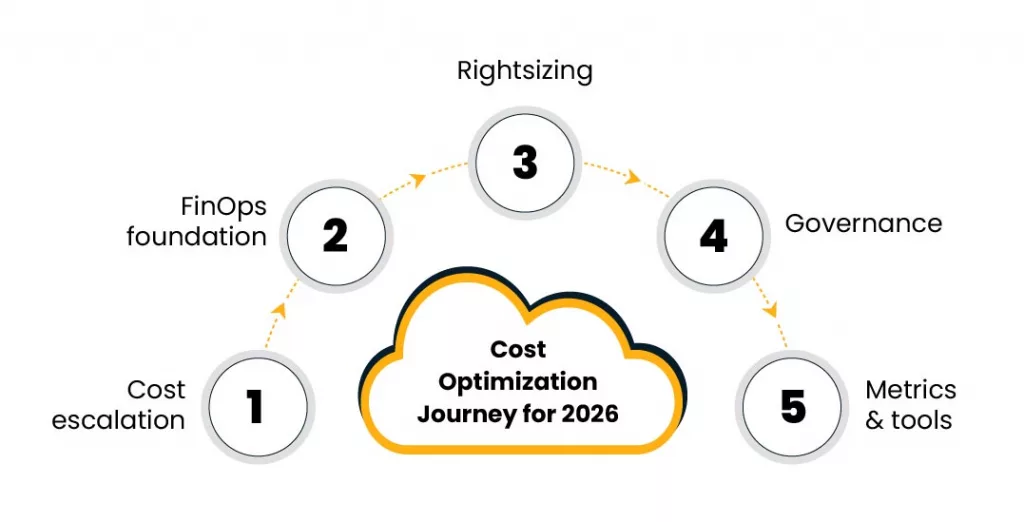
In this blog, we will break down how organizations can regain cost control with result-driven cloud cost optimization strategies. We will start by understanding why cloud costs escalate in the first place, then move into FinOps fundamentals, practical rightsizing techniques, governance models, and finally the metrics and tools that matter in 2026.
Understanding the Basics of FinOps for Cloud Cost Optimization
Once cloud costs start escalating, most organizations react by asking a familiar question: Who is responsible for this spend?
FinOps exists to answer that question clearly and consistently.
FinOps, or Cloud Financial Operations, is a structured operating model that brings finance, engineering, and business teams onto the same page. Its purpose is not just to reduce costs, but to ensure every cloud dollar spent is intentional, visible, and tied to business outcomes.
According to the FinOps Foundation’s 2025 State of FinOps Report, 67% of organizations now have formal FinOps practice embedded in their organization.
At its core, FinOps is built on three simple principles.
First, visibility. Organization needs real-time insight into where money is being spent, by whom, and for what purpose. Without shared cost visibility, optimization strategies remain reactive and fragmented.
Second, ownership. FinOps shifts accountability closer to the teams that create cloud consumption. When engineering teams understand the cost impact of their architectural decisions, cloud cost optimization best practices become part of daily work, not a finance-driven afterthought.
Third, continuous optimization. Cloud environments change constantly. New services, workloads, and experiments are added every week. FinOps treats optimization as an ongoing cycle, not a quarterly review or annual cost-cutting initiative.
In practice, FinOps acts as the foundation for cloud infrastructure optimization. It creates guardrails for decision-making without slowing down innovation. Teams can still scale, experiment, and deploy quickly, but with financial context built into those decisions.
As cloud usage expands in 2026, FinOps is the baseline required to move from uncontrolled cloud spending to sustainable, value-driven cloud cost optimization.
Rightsizing as a Core Cloud Infrastructure Optimization Strategy
After cost visibility and ownership are in place, the next logical step is fixing what is already overprovisioned. This is where rightsizing delivers immediate and measurable impact.
Rightsizing is the practice of matching cloud resources to actual workload requirements. Over time, most environments drift away from this balance.
- Virtual machines are sized for peak traffic that never arrives.
- Databases are overpowered for safety.
- Storage grows unchecked because it is easier to add than to review.
Individually, these decisions seem harmless. Collectively, they drive persistently overspending.
Effective rightsizing starts with usage data, not assumptions. CPU utilization, memory consumption, disk IOPS, and network throughput reveal how resources are actually used in production. When this data is reviewed consistently, patterns emerge. Many workloads run well below their allocated capacity, creating a clear opportunity for cloud infrastructure optimization.
However, rightsizing is not about aggressive downsizing. Cutting capacity without understanding performance impact introduces risk. The goal is to have stability with efficiency. That means resizing resources gradually, validating performance, and building rollback options into the process.
Rightsizing also extends beyond compute. Storage tiers, database instance types, and autoscaling configurations all play a role in sustainable cloud cost optimization strategies. When aligned with FinOps principles, rightsizing becomes a repeatable practice rather than a one-time cost-saving exercise.
Done correctly, rightsizing helps organizations reduce waste while maintaining reliability. It creates quick wins, builds confidence in cloud cost optimization best practices, and lays the groundwork for stronger governance and long-term cost control.
Building Governance-First Cloud Cost Optimization Best Practices
Governance is what prevents cloud costs from creeping back after initial optimization efforts. Without it, rightsizing gains are temporary, and FinOps’ initiatives lose momentum.
Effective optimization strategies depend on cloud governance models that are proactive, practical, and enforceable. Below are some prominent best practices that support long-term cloud infrastructure optimization.
1. Establish clear cost ownership across teams
Every cloud resource should have a clearly defined owner. When ownership is shared or unclear, accountability breaks down. Assign responsibility at the application, service, or business-unit level, so teams understand both usage and cost impact.
2. Standardize tagging and resource classification
Consistent tagging is foundational to cloud cost optimization best practices. Tags for environment, application, owner, and cost center enable accurate reporting, chargeback, and optimization decisions. Governance should enforce mandatory tagging at provisioning, not after deployment.
3. Implement budget thresholds and alerts early
Budgets should act as guardrails, not post-spend reports. Set cost thresholds by team, project, or workload and trigger alerts before limits are breached. This allows teams to course-correct without slowing down delivery.
4. Control access with least-privilege policies
Unrestricted access leads to uncontrolled provisioning. Apply role-based access controls so teams can deploy what they need, but within defined boundaries. This reduces accidental overspending while supporting cloud infrastructure optimization.
5. Enforce standards through automation, not manual reviews
Manual governance does not scale. Use policies and automation to enforce approved instance types, storage tiers, and deployment patterns. Automated guardrails reduce friction while keeping cloud cost optimization strategies consistent.
6. Review governance policies on a regular cadence
Cloud usage evolves quickly. Governance models must evolve with it. Schedule periodic reviews to align policies with new services, changing workloads, and business priorities. Stagnant governance is as risky as there is no governance at all.
Strong governance does not slow teams down. It creates clarity, accountability, and repeatability. When embedded correctly, governance turns cloud cost optimization from a corrective action into a built-in operating discipline.
Cloud Cost Optimization Metrics and Tools to Track
Effective cloud cost optimization strategies rely on tracking a focused set of metrics and using tools that support continuous decision-making.
Key metrics to monitor
- Cost per workload or application to link spend with business value
- Resource utilization to identify overprovisioned compute, storage, and databases
- Unit economics such as cost per transaction or user
- Idle and waste spend from unused or underutilized resources
- Forecast accuracy to measure planning and governance maturity
Tools that enable optimization
Native cloud cost tools provide basic visibility, budgeting, and alerts. FinOps platforms add deeper insights, automated recommendations, and cross-cloud visibility. Performance and observability tools complement cost data by revealing rightsizing opportunities.
Together, the right metrics and tools help teams move from reactive cost control to disciplined cloud infrastructure optimization.
Conclusion: Turning Cloud Cost Optimization into a Continuous Practice
Cloud cost optimization is not a short-term savings or periodic change; it is about building the right systems and using the right resources to prevent waste before it occurs.
If your enterprise cloud spend is rising, then it reflects gaps in visibility, ownership, and governance. Organizations can overcome these cost challenges by,
- Including optimization efforts in FinOps fundamentals
- Applying rightsizing discipline
- Enforcing governance-first cloud cost optimization best practices
- Tracking the right metrics
Organizations can regain control without slowing innovation by partnering with a cloud engineering services provider.
At Cygnet.one, we make cloud spending predictable, intentional, and directly tied to business value with our result-driven cloud optimization strategies formed by our cloud experts. By defining the right strategy, FinOps best practices, we make cloud infrastructure optimization as a part of daily engineering and business decisions to offer you enhanced cost efficiency. Let’s collaborate and move cost optimization strategies from occasional audits to integral part of day-to-day operations.
Author


Yogita Jain
Content Lead
Yogita Jain leads with storytelling and Insightful content that connects with the audiences. She’s the voice behind the brand’s digital presence, translating complex tech like cloud modernization and enterprise AI into narratives that spark interest and drive action. With a diverse of experience across IT and digital transformation, Yogita blends strategic thinking with editorial craft, shaping content that’s sharp, relevant, and grounded in real business outcomes. At Cygnet, she’s not just building content pipelines; she’s building conversations that matter to clients, partners, and decision-makers alike.
