


































Key Milestones & Implementation Timeline
Q4 2024
Development Service Providers’ certification requirements and procedures.
Q2 2025
Introduction of e-Invoicing legislation.
July 2026
phase 1 – go live reporting for B2B & B2G e-Invoicing
March–April 2025
Dedicated portal for e-Invoicing Service Providers Accreditation in the UAE.
December 2025
Pilot Phase begins for UAE e-Invoicing implementation.
On the Horizon
Potential inclusion of Business-to-Consumer (B2C) transactions.

Specialized e-Invoicing PEPPOL Model in UAE
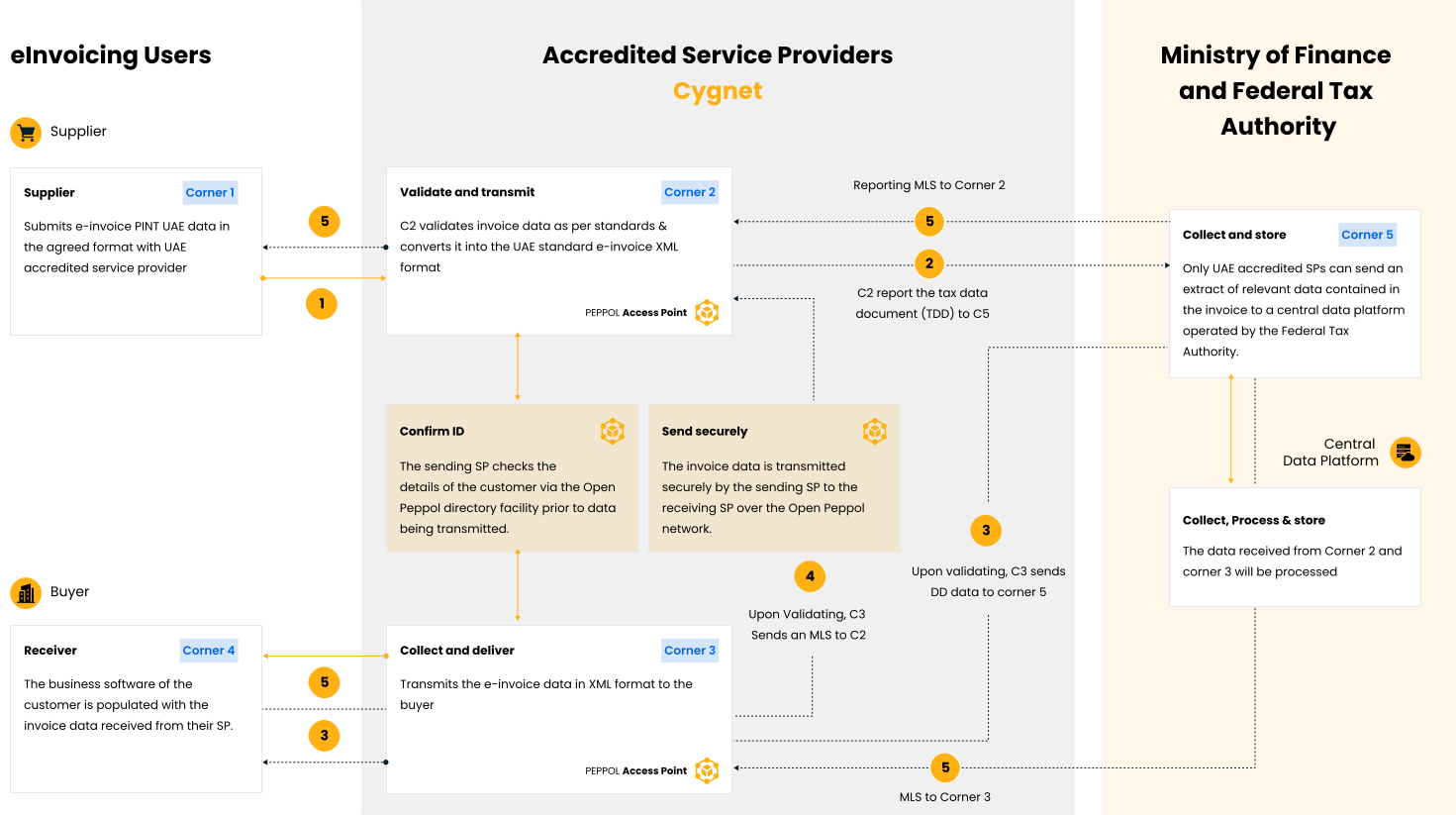
- Supplier, Corner 1 (C1) transmits e-Invoice data in an agreed format to its UAE-accredited Service Provider, Corner 2 (C2).
- Corner 2 (C2) validates the e-Invoice data received from Corner 1 (C1) and converts it into the UAE-standard e-Invoice XML format if necessary (i.e., if the original format differs from the UAE standard).
- C2 transmits the e-Invoice (in the XML format) to the buyer’s UAE-accredited Service Provider, Corner 3 (C3).
- Corner 3 (C3) sends an acknowledgment to C2, confirming successful receipt of the e-Invoice, and then transmits the e-Invoice to the buyer, Corner 4 (C4).
- C2 reports the tax-related data of the e-Invoice to the central data platform managed by the FTA, Corner 5 (C5).
- Corner 5 (C5) sends an acknowledgment to C2, confirming that the e-Invoice has been successfully reported.
- C2 forwards both the C3 exchange acknowledgment and the C5 reporting acknowledgment to C1.

Challenges & How We Solve Them
Common e-Invoicing Challenges
- Manual errors & compliance risks
- Data inconsistency & integration issues
- Lack of real-time tracking & validation
- Data security & privacy concerns
- Archiving & audit compliance complexities
Cygnet.One’s Solution
- Automated tax compliance Eliminates manual errors & ensures regulatory adherence
- End-to-end integration Seamless connectivity with existing ERP, legacy & accounting systems
- Real-time tracking & reporting Ensures accuracy & transparency
- Robust data security & privacy Encrypted storage & secured data handling
- Archiving & audit compliance Minimum 5 years of legally compliant data retention
Solution Overview
Global Trust & Accreditations
0 M+
Global Trust & Accreditations
0 M
Transactions Monthly
0 %
of Nifty 50 Companies Trust Us
Certified & Accredited with Global Tax Authorities

Ensure seamless UAE e-Invoicing compliance with a PEPPOL- accredited provider.
Stay compliant, error-free, and audit-ready with our expertise.
Our Certifications















Our Accreditations
With tax authorities across the globe

PEPPOL
Certified solution provider

FTA
Recognized VAT platform in UAE
Muwafaq
FTA recognized
ZATCA
Recognized e-Invoicing service provider
IRP
GSTN Approved
GSP
GSTN Approved

MDEC
Certified solution provider
HMRC
Recognized VAT platform in UK
BOSA
Registered e-Invoice Compliant Software in Belgium
Resources

e-Invoicing Integration: Connecting Your Systems Seamlessly in the UAE
Know how businesses in UAE can fully leverage the benefits e-invoicing. Read to understand about integration strategy, selecting the right ASP, addressing potential hurdles and more.

The Role of AI in Enhancing e-Invoicing Efficiency in the UAE
AI in e-invoicing addresses complex situations & offers predictive capabilities & benefits that enhance e-invoicing. Know more on the benefits of AI in e-invoicing.

UAE E-invoicing Mandate: A Comprehensive Guide
Explore the details of the UAE E-Invoicing mandate with our complete guide. Ensure compliance and enhance operational efficiency.
Your Questions Answered
UAE e-Invoicing refers to the structured electronic generation, validation, and exchange of invoices in line with the Federal Tax Authority’s upcoming mandate. Starting July 2026, all B2B and B2G transactions will need to follow a standardized, real-time reporting model using the Peppol framework. This applies to most VAT-registered businesses operating in the UAE.
Not exactly. While both follow a Continuous Transaction Controls (CTC) framework, Saudi Arabia (ZATCA) uses a 2-Corner direct clearance model, where invoices are sent straight from the taxpayer to the tax authority for approval.
In contrast, the UAE has adopted a 5-Corner Peppol-based model, involving intermediaries like Access Points (APs) and Service Metadata Publishers (SMPs). Here, invoices are validated and routed through Peppol infrastructure, with the FTA receiving a copy for compliance and audit purposes. This approach supports interoperability and is better suited for international and B2B workflows.
The 5-Corner model includes:
- Corner 1: Seller
- Corner 2: Seller’s Access Point (AP)
- Corner 3: Buyer’s Access Point (AP)
- Corner 4: Buyer
- Corner 5: UAE FTA (as validating authority)
Invoices flow from the seller to FTA via AP, are validated, and then delivered to the buyer via the SMP — ensuring secure, verified, and real-time tax data exchange.
PINT-AE is the UAE-specific adaptation of the Peppol International Invoice (PINT) standard. It builds on the global Peppol framework but includes UAE-specific business rules, field-level validations, and mandatory data requirements as outlined by the Ministry of Finance.
To comply with the upcoming mandate, businesses must ensure their ERP or invoicing systems can generate e-Invoices in this exact XML format, otherwise, the invoices will be rejected during validation by the FTA.
Not at all. Most businesses can continue using their existing ERP (SAP, Oracle, Dynamics, Tally, etc.), as long as the ERP can generate data in the required format and push it through an accredited intermediary (like an ASP or AP). Cygnet.One offers ready connectors and middleware to bridge the gap without overhauling your existing systems.
For most mid to large enterprises, it takes between 6 to 10 weeks to assess ERP readiness, map the invoice fields to PINT-AE, conduct sandbox testing, and go live with e-Invoice generation and exchange. Starting early ensures you’re not racing against the July 2026 deadline.
Some common roadblocks include:
- Identifying multiple invoice types and transaction flows
- Extracting clean data from ERPs or legacy systems
- Cleansing and standardizing master data — such as buyer/supplier details, VAT numbers, and item codes
- Dealing with corrections or cancellations
- Ensuring real-time integration with FTA and buyers’ SMPs
That’s where a compliance-focused integrator like Cygnet.One adds value — simplifying the process from start to scale.
While penalties haven’t been finalized, failure to comply may result in rejection of invoices, delays in VAT claim approvals, or regulatory fines. Non-compliance could also trigger tax authority audits or impact your business’s ability to transact with government bodies or large enterprises.
Absolutely. With real-time validations, standardized formats, and API-based VAT filing, you gain:
E-Invoicing isn’t just a regulation — it’s a gateway to smarter finance and tax processes.
Cygnet.One is already trusted by tax authorities and enterprises across 35+ countries. We’re Peppol-aligned, ISO-certified, and equipped to handle end-to-end e-Invoicing – from ERP integration to ASP onboarding and PINT-AE validation. Plus, our local UAE support and domain expertise ensure your compliance journey is smooth, timely, and audit-proof.
Yes, UAE e‑Invoices can include a mix of taxable, exempt, or out‑of‑scope goods and services. The PINT‑AE format accommodates multiple tax treatments in a single invoice. Just make sure each line item clearly indicates its tax status. Your ASP will flag any inconsistencies before it goes to the FTA.
If your company is part of a VAT group, each legal entity must have its own Peppol endpoint through an Accredited Service Provider. While the Group TRN remains the same, invoices must route through the entity-specific endpoint for accurate tracking and compliance.
Unlike domestic B2B/B2G transactions, export invoices aren’t automatically transmitted via the Peppol network unless the overseas buyer is already registered. If they aren’t, your ASP still validates the invoice and reports tax details to the FTA, while you deliver the invoice to your buyer via email or your usual export process.
As per FTA regulations, all e‑Invoices must be stored securely for at least 5 years, with an optional extension of up to 9 years in specific cases (like real estate). Your ASP should support tamper-proof archiving and enable audit retrieval on demand.
Yes, but to connect with the FTA, businesses must still work with an Accredited Service Provider (ASP). Even with a custom system, invoices must be validated and transmitted through a certified ASP using the Peppol network and PINT-AE format. Building this independently is possible, but often complex, costly, and hard to scale.
The mandate aims for near real-time invoice exchange, within seconds or minutes, between your system and your ASP. That’s where middleware like ours can help manage API, SFTP, or database triggers so invoices don’t sit pending manually.
In self‑billing situations (where the buyer issues the invoice on behalf of the seller), the buyer becomes the “Corner 1” issuer—they create and transmit the invoice to the Corner 2 ASP, which then validates, reports, and forwards it to the seller (Corner 5 back to 4). Your chosen ASP needs to support this flow.
Peppol (Pan-European Public Procurement Online) is a global framework for structured electronic document exchange (e.g., e-invoices, orders) via certified Access Points (APs). It is governed and maintained by OpenPeppol AISBL, a non-profit international association headquartered in Belgium.
For UAE, a localized Peppol Authority instance is being established by the Federal Tax Authority (FTA) to align with national regulatory requirements. Cygnet, as a certified Peppol Access Point and SMP provider, is fully integrated with this UAE-specific setup.
No, the Peppol network is not built on blockchain. It uses secure, interoperable, and standardized protocols (e.g., AS4) for document transmission between Access Points. Trust is ensured through certificate-based validation and SMP discovery, not blockchain.
Businesses cannot self-register directly on the Peppol network. They must onboard via a certified Peppol Access Point provider, such as Cygnet.
Yes, if the recipient is located in another Peppol-compliant country, cross-border B2B/B2G e-invoices must be transmitted via the Peppol network.
Even if the schema used by the receiving country differs, Cygnet handles schema translation to ensure compliance with both UAE FTA and recipient country formats.
If an invoice is cleared and reported to the FTA, but subsequently rejected by the buyer:
- Cygnet allows the issuer to flag the invoice as rejected using cancellation or credit note workflows.
- This ensures accurate audit trails and avoids reporting mismatches with the FTA.
When transitioning from another ASP:
- Your Peppol ID remains the same but needs to be re-mapped through Cygnet’s SMP.
- Historical data is not automatically migrated, but Cygnet provides secure data import utilities and archiving options to ensure continuity and FTA audit compliance.
Yes. Cygnet supports:
- Flat-file/API-based integration layers that decouple the e-invoice workflow from the ERP core.
- You can generate invoice data from legacy ERP (CSV/XML), and later switch to real-time APIs with the new ERP, without re-onboarding.
- Our data abstraction layer ensures continuity during transition.